
Overpressure failures damage pipelines, stop production, and risk lives. You need a system that detects pressure spikes early and reacts instantly. This guide shows how a Pressure Monitor Alert & Control System prevents failures using real-time sensing, automation, and smart shutdown logic.
Overview & Key Aspects
A pressure monitoring system tracks pipeline pressure and keeps it within safe limits.
Core idea
- Measure pressure continuously
- Detect abnormal spikes or drops
- Trigger automatic action
- Pressure range: 0 to 10 bar
- Accuracy: ±0.25% to ±1% FS
- Output: 4–20 mA, 0–10 V, RS485
- Protection: IP65 / IP67
- Works with PLC, DCS, SCADA
How It Is Used & Works
Working Principle
- Sensors read pressure in real time
- Data goes to PLC or SCADA
- System compares with safe limits
- If limits exceed:
- Alerts trigger
- Valves act
- System shuts down if needed
Key flow
- Detect → Analyze → Act → Protect
Visual: Pressure Monitoring Flow
Key Components of Pressure Monitor & Control Systems
You need these parts working together:
- Real-time Sensors (IoT-enabled)
High accuracy, continuous monitoring - SCADA Integration
Central control and remote monitoring - Pressure Relief Valves (PRV)
Release excess pressure safely - Slam-shut / Emergency Valves
Instant flow cut-off - Surge Protection Devices
Handle water hammer spikes
Key Prevention Techniques
Use multiple layers of protection
- Combine sensors + PRV + slam-shut valves
- Use worker-monitor-slam-shut setup
- Enable automatic pump shutdown
- Detect reverse flow instantly
- Monitor low-pressure waves before surge spikes
Predictive monitoring
- Track corrosion
- Detect weak pipeline zones
- Prevent failure before it happens
Key Features and Technology
- High accuracy sensors
- Wide pressure range
- Multiple outputs for integration
- Harsh environment durability
- SCADA compatibility
- Low maintenance design
Key Benefits & Specifications
Benefits you get
- Prevent pipeline rupture
- Reduce downtime
- Improve safety compliance
- Lower maintenance cost
- Real-time decision making
Specs summary
- Temp range: –20°C to +85°C
- Power: 12–36 V DC / 230 V AC
- Flexible installation
Comparison Table
| Feature | Basic System | Advanced Pressure Monitor System |
|---|---|---|
| Monitoring | Manual | Real-time |
| Response | Slow | Instant |
| Automation | No | Yes |
| Safety | Low | High |
| Integration | Limited | PLC / SCADA |
| Failure Risk | High | Low |
Key Application Areas & Reasons
- Oil pipelines → Prevent rupture
- Refineries → Control pressure fluctuations
- Petrochemical plants → Avoid explosion risks
- Storage tanks → Maintain safe levels
Required Components
- Pressure sensors
- PLC / DCS system
- SCADA software
- Control valves
- Communication modules (RS485)
- Power supply
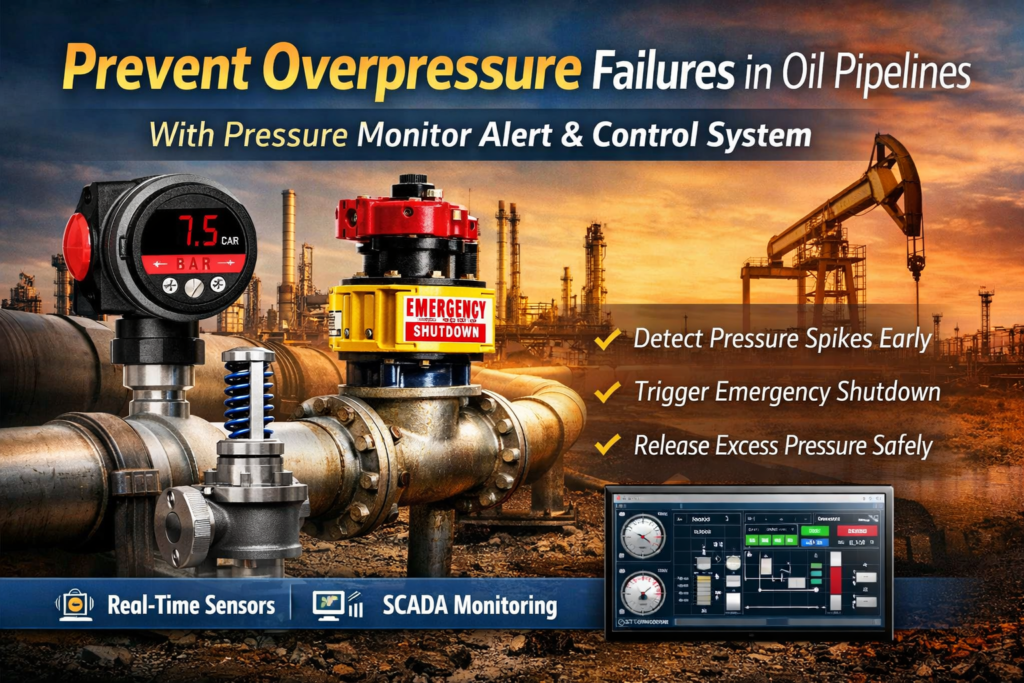
Operations & Functions
- Continuous monitoring
- Alert generation
- Automated shutdown
- Data logging
- Remote control
Steps to Follow
- Install sensors at critical points
- Connect to PLC / SCADA
- Set pressure limits
- Configure alarms
- Enable automated control
- Test emergency shutdown
Checklist for You
- Sensors calibrated
- Alarm limits defined
- SCADA connected
- Valves tested
- Backup power ready
- Maintenance schedule active
Examples
- Pump failure causes low pressure → system detects → surge predicted → valves adjust
- Sudden pressure spike → PRV releases pressure → prevents rupture
Advantages and Disadvantages
Advantages
- Fast response
- High accuracy
- Reduced human error
- Better safety
Disadvantages
- Initial setup cost
- Requires skilled configuration
Compliance and Best Practices
- Maintain regular calibration
- Use redundant systems
- Perform periodic safety audits
- Keep data logs for inspection
Internal Links
- https://www.kathirsudhirautomation.com/industrial-automation-solutions
- https://www.kathirsudhirautomation.com/pressure-control-system-used-in-manufacturing
- https://www.kathirsudhirautomation.com/industrial-automation-need-pressure-control-system
Pro Tip
Use predictive analytics with SCADA data. It helps you detect pressure trends before failure happens.
Conclusion
Overpressure failures are preventable when you use real-time monitoring, automated controls, and multi-layer protection. A well-designed pressure monitor alert system keeps your pipeline safe, stable, and compliant.
FAQs
1. Which is the best pressure monitoring system to prevent overpressure failures?
A system with real-time sensors, SCADA integration, and automated valves gives the best protection.
2. How to design an effective overpressure protection system?
Use multi-layer protection, set pressure limits, automate shutdown, and integrate SCADA.
3. How do these systems reduce pipeline rupture risks?
They detect pressure spikes early and trigger instant corrective actions.
4. What are the key components?
Sensors, PLC, SCADA, PRV, slam-shut valves, and surge protection devices.
5. Top companies offering solutions in India
Companies like Honeywell, Siemens, and Schneider Electric.
6. Best practices in India
- Follow API standards
- Use automation
- Maintain systems regularly
7. Features to look for
- High accuracy
- SCADA compatibility
- Real-time alerts
- Durable design
8. Function of a safety instrumented system
It monitors risk conditions and triggers automatic shutdown to prevent accidents.
9. Cost-effective pressure alert systems
Systems with modular sensors and scalable SCADA integration reduce cost.
10. Cost-effective solutions again
Use standardized components + predictive maintenance to reduce long-term expense.

Kathir Sudhir Automation India specializes in advanced motion control systems, industrial automation solutions, and medical-grade linear actuator technologies for healthcare and rehabilitation equipment manufacturers.
With recognized industry certifications and multiple awards for innovation in automation systems, the company delivers reliable, high-performance electromechanical solutions tailored for medical and industrial applications.
Certifications & Recognition
Zed Bronze Certificate
Member at Confederation of Indian Industry (CII)
TANSTIA Member Certificate