
Pressure control drives safety, quality, and uptime in manufacturing. A pressure monitor alert and control system tracks real-time pressure and reacts fast to keep processes within limits. It reduces failures, avoids downtime, and keeps output consistent.
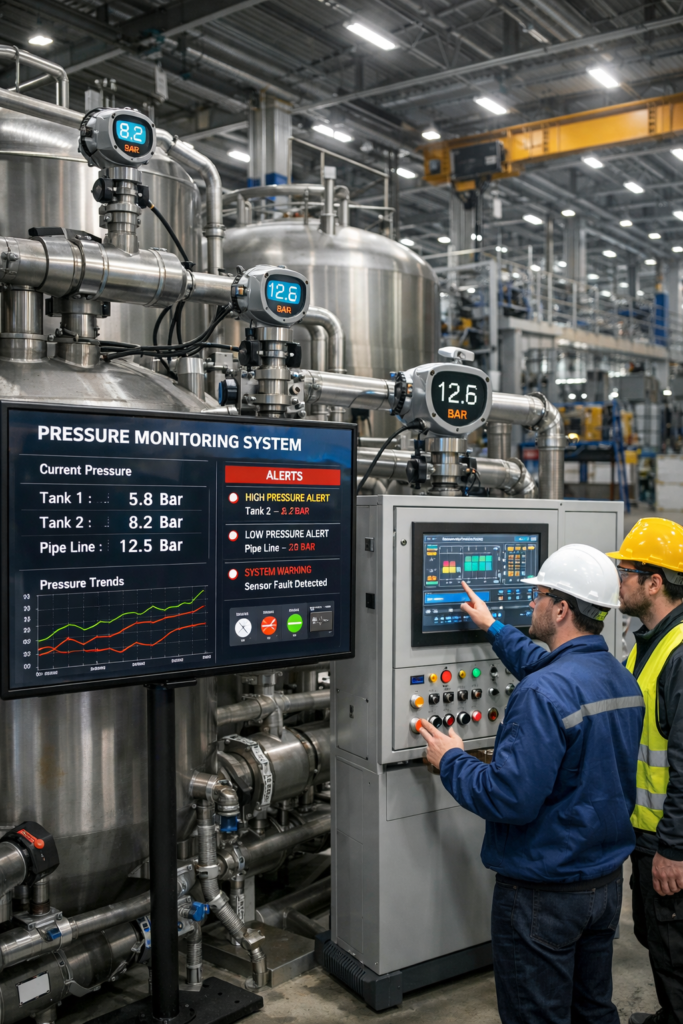
Enhancing Industrial Pressure Monitoring in Manufacturing
Manufacturing plants deal with compressed air, liquids, steam, and gases. Each process needs stable pressure. A pressure monitor system reads pressure values and sends signals to controllers like PLC or SCADA.
It improves:
- Process stability in production lines
- Equipment life by avoiding overpressure
- Product consistency in batch operations
Industries like cement, steel, automotive, and water treatment rely on this system daily.
Intelligence at the Edge
Modern systems process data close to the source. Sensors and controllers react instantly without waiting for central systems.
This gives you:
- Faster response to pressure changes
- Real-time alerts and automation
- Reduced dependency on manual checks
Edge intelligence helps prevent accidents before they happen.
How Manufacturing Uses Pressure Monitoring
Manufacturers use these systems in pipelines, tanks, compressors, and hydraulic systems. The system measures pressure and adjusts valves, pumps, or actuators.
Example:
In a compressed air system, if pressure drops below 5 bar, the controller starts a compressor. If it exceeds 8 bar, it releases pressure or shuts off the system.
How It Works
A pressure sensor detects pressure in a system. It converts it into signals like 4–20 mA or 0–10 V. These signals go to a controller. The controller compares actual pressure with set limits. It triggers alarms or controls devices.
Core flow:
Sensor → Signal → Controller → Action
Required Components
- Pressure sensor or transmitter
- Controller, PLC, or relay unit
- Power supply
- Output devices like valves or motors
- Display unit or HMI
- Communication interface like RS485
Operations and Functions
- Continuous pressure measurement
- Real-time monitoring
- Automatic control actions
- Alarm generation
- Data logging and reporting
Key Features and Technology
Based on the product:
- Pressure range from 0 to 10 bar
- Outputs include 4–20 mA, 0–10 V, RS485
- Accuracy up to ±0.25% FS
- IP65 or IP67 protection
- Works in –20°C to +85°C
- Compatible with PLC, DCS, SCADA
Key Benefits and Specifications
You get:
- High accuracy and stability
- Wide pressure range support
- Strong build for harsh environments
- Easy installation
- Low maintenance cost
Advantages and Disadvantages
Advantages
- Improves safety
- Reduces downtime
- Saves energy
- Supports automation
Disadvantages
- Initial setup cost
- Requires calibration
- Needs skilled integration
Key Application Areas
- Industrial automation
- Oil and gas
- Power plants
- HVAC systems
- Water treatment
- Automotive manufacturing
Steps to Follow
- Identify pressure points in your system
- Choose the right sensor range
- Install sensor and controller
- Set pressure limits
- Integrate with PLC or SCADA
- Test and calibrate
- Monitor regularly
Checklist for You
- Correct pressure range selected
- Proper mounting and sealing
- Power supply stable
- Output signal compatible
- Alarm limits configured
- System tested under load
Examples
- Boiler system uses pressure control to avoid explosions
- Hydraulic press maintains consistent force using pressure monitoring
- Water treatment plant controls pump pressure to maintain flow
Key Aspects
- Accuracy and response time
- Environmental resistance
- Integration capability
- Maintenance needs
- Signal compatibility
Comparison Table
| Feature | Basic System | Advanced System |
|---|---|---|
| Accuracy | Moderate | High |
| Output Signals | Limited | Multiple |
| Automation | Manual/Partial | Fully automated |
| Integration | Low | PLC/SCADA ready |
| Cost | Low | Higher |
Conclusion
Pressure monitoring is not optional in modern manufacturing. It keeps operations stable, safe, and efficient. A well-designed alert and control system helps you avoid costly failures and improve productivity.
FAQs
1. What is a pressure monitoring system?
It measures and controls pressure in industrial systems to maintain safe limits.
2. Why is pressure monitoring important in manufacturing?
It prevents equipment damage, ensures safety, and maintains product quality.
3. What output signals are used in pressure systems?
Common outputs include 4–20 mA, 0–10 V, and RS485.
4. How accurate are pressure sensors?
They range from ±0.25% to ±1% full scale.
5. Where is pressure monitoring used?
Used in pipelines, tanks, compressors, and hydraulic systems.
6. What happens if pressure exceeds limits?
The system triggers alarms or shuts down equipment.
7. Can pressure systems integrate with automation?
Yes, they work with PLC, DCS, and SCADA systems.
8. What industries use pressure monitoring?
Oil and gas, power, water treatment, manufacturing, HVAC.
9. What is the typical pressure range?
Many systems operate from 0 to 10 bar or higher.
10. Is maintenance required?
Yes, periodic calibration and inspection are needed for accuracy.

Kathir Sudhir Automation India specializes in advanced motion control systems, industrial automation solutions, and medical-grade linear actuator technologies for healthcare and rehabilitation equipment manufacturers.
With recognized industry certifications and multiple awards for innovation in automation systems, the company delivers reliable, high-performance electromechanical solutions tailored for medical and industrial applications.
Certifications & Recognition
Zed Bronze Certificate
Member at Confederation of Indian Industry (CII)
TANSTIA Member Certificate