
In today’s competitive manufacturing world, speed, precision, and reliability decide who stays ahead. Special Purpose Machines (SPMs) are built to do one thing—and do it exceptionally well. From assembly stations to testing rigs, these machines are the backbone of high-volume, high-accuracy production. But behind every smooth motion and accurate operation lies one unsung hero: the electric actuator.
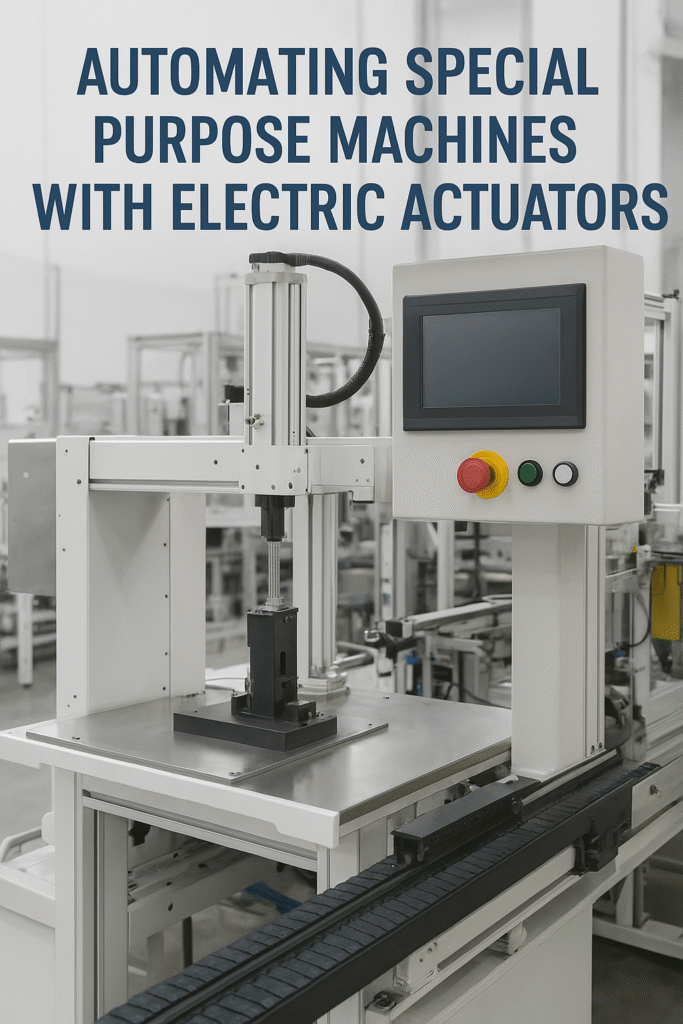
The Shift from Conventional Systems
Traditionally, SPMs have been powered by pneumatic or hydraulic systems. While they served the purpose, they often came with challenges—oil leaks, high maintenance costs, complex piping, and limited precision. Manufacturers began searching for a smarter, cleaner, and more efficient solution. That’s where electric actuators stepped in.
Why Electric Actuators in SPMs?
Electric actuators are not just replacements; they are enablers of innovation. Here’s why industries are rapidly adopting them in their SPMs:
- Precision at Every Step – Control movement down to microns for assembly or testing tasks.
- Programmable Motion – Adjust speed, stroke, and force instantly without mechanical changes.
- Clean Operation – No fluids, no leaks, no mess—ideal for modern shop floors.
- Energy Efficiency – Power is used only when needed, unlike compressors running 24/7.
Applications of Electric Actuators in SPMs
- Assembly Systems – For inserting, pressing, or fastening with controlled force.
- Material Handling Units – Smooth pick-and-place operations without jerks.
- Inspection and Testing Rigs – Applying repeatable loads for endurance and validation.
- Cutting, Marking, or Sorting Machines – High-speed precision with minimal downtime.
A Story from the Shop Floor
Imagine a manufacturer struggling with downtime because their hydraulic system keeps leaking. Every few days, production halts, technicians rush to fix it, and delivery schedules get delayed. After switching to electric actuators, breakdowns vanish, motion becomes smoother, and operators now program new settings within minutes. What was once a headache has turned into a competitive advantage.
Future of SPM Automation
Electric actuators are more than just a trend—they are shaping the future of automation. With Industry 4.0 integration, they connect seamlessly with sensors, PLCs, and monitoring systems, providing real-time feedback. This makes SPMs smarter, faster, and capable of adapting to evolving production demands.
Conclusion
Special Purpose Machines are built to perform dedicated tasks with unmatched efficiency. By integrating electric actuators, industries are not just improving reliability but also future-proofing their operations. From reducing downtime to achieving precision at scale, electric actuators are redefining how SPMs deliver performance.
