
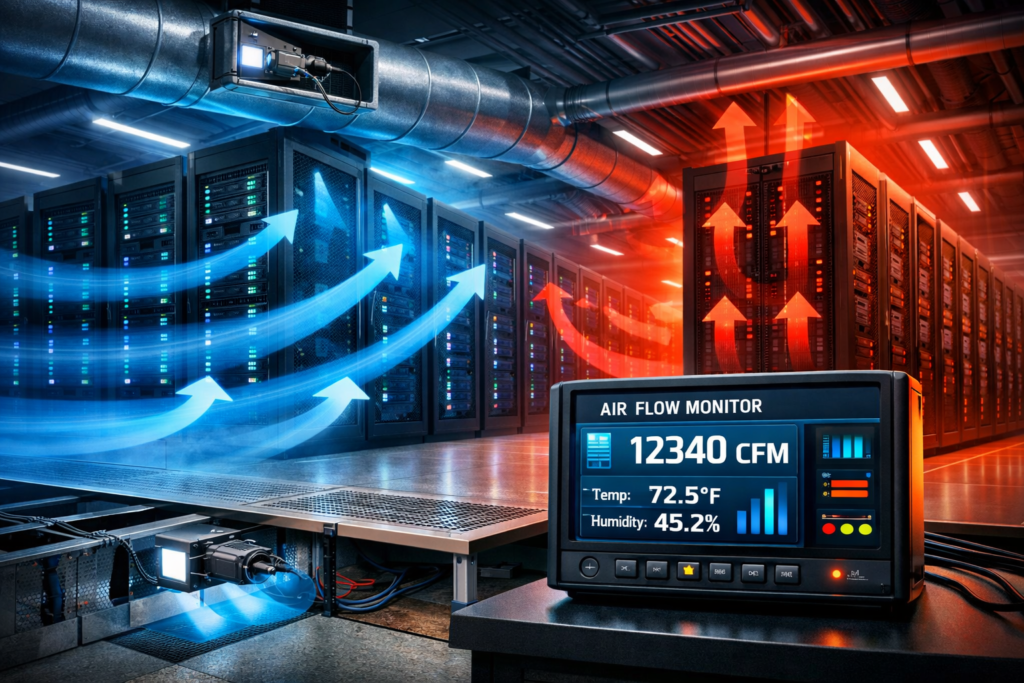
Modern data centers run thousands of servers that generate a significant amount of heat. Without proper airflow management, this heat can quickly affect equipment performance and reliability. An Air Flow Monitor & Control System helps maintain consistent cooling by monitoring airflow in real time and automatically adjusting ventilation systems. This ensures stable temperatures, reduces energy consumption, and prevents costly downtime in critical IT infrastructure.
The Necessity of Proper Air flow Monitoring Technology
In high-performance environments such as data centers, maintaining the correct airflow is not simply about comfort—it is about equipment protection and operational stability. Servers, networking devices, and storage systems produce continuous heat while processing large volumes of data. If airflow becomes restricted or poorly distributed, hot spots develop within server racks.
Airflow monitoring technology continuously measures the volume and velocity of air moving through ducts, raised floors, and cooling zones. By using sensors and control modules, the system can automatically regulate fans, dampers, or HVAC components. According to the product specification, the system measures real-time airflow and adjusts fans or dampers to maintain the required flow levels while triggering alerts when airflow moves outside preset limits.
Without proper monitoring, cooling systems may run inefficiently or fail to deliver adequate airflow to critical equipment.
Air flow Monitoring and Why It Matters in Commercial HVAC
Commercial HVAC systems play a critical role in data center cooling. Unlike traditional office buildings, data centers require precise airflow distribution to ensure each rack receives sufficient cooling.
Airflow monitoring allows facility managers to observe how air moves through ducts, containment aisles, and server racks. This visibility helps prevent:
- Uneven cooling
- Energy waste
- Overloaded cooling units
- Equipment overheating
When integrated with airflow control systems, HVAC units such as CRAC (Computer Room Air Conditioner) and CRAH (Computer Room Air Handler) can automatically adjust their performance based on actual cooling demand.
Air flow Measurement — How Sensors Capture Accurate HVAC Data
Airflow measurement systems rely on advanced sensors placed inside ventilation ducts or airflow paths. These sensors detect air velocity, pressure differences, and thermal changes.
Typical airflow sensors used include:
- Thermal airflow sensors
- Vane anemometers
- Differential pressure sensors
These sensors convert airflow data into electrical signals, which can then be transmitted to monitoring systems through outputs such as 4–20 mA, 0–10 V, or digital communication protocols like RS485/Modbus.
This data enables precise monitoring of airflow conditions across the entire cooling infrastructure.
How Modern Air flow Sensors Work
Modern airflow monitoring devices combine sensing technology, signal processing, and automation controls. The sensors continuously detect airflow velocity or thermal changes caused by moving air.
The control system then processes this data and performs several important functions:
- Displays airflow range in CFM
- Monitors temperature and humidity
- Detects threshold conditions
- Activates alarms or alerts
- Controls dampers or fans
Many advanced systems also provide sound alarms, SMS alerts, email notifications, and data logging features for operational analysis.
Why Accuracy Matters
Accurate airflow measurement is essential in data centers because even a small variation can cause uneven cooling. Servers operate within specific thermal limits, and inaccurate readings may lead to overheating or excessive cooling.
The airflow monitoring system typically offers ±2–3% measurement accuracy, ensuring reliable airflow data for automated control decisions.
Accurate data helps facility managers maintain optimal airflow distribution while avoiding unnecessary energy usage.
Thermal Dispersion Air flow Technology Explained
Thermal dispersion technology is one of the most reliable methods used in airflow monitoring systems. It works by measuring how heat dissipates from a heated sensor probe when air flows across it.
When airflow increases, heat is carried away faster. When airflow decreases, less heat is removed. The sensor measures this thermal change and calculates airflow velocity accordingly.
This method provides several advantages:
- High sensitivity
- Stable measurements
- Minimal maintenance
- Wide airflow range detection
Because of these characteristics, thermal dispersion sensors are commonly used in HVAC ducts, clean rooms, laboratories, and data centers.
Air Flow Control in Critical Facilities (Hospitals, Labs, Data Centers)
Airflow control systems are essential in environments where air quality and temperature stability are critical.
These include:
- Data centers
- Hospitals
- Research laboratories
- Clean rooms
- Industrial manufacturing facilities
In these locations, airflow monitoring helps maintain:
- Proper ventilation
- Safe air pressure levels
- Controlled temperature environments
- Contamination-free spaces
By maintaining controlled airflow, these facilities can ensure safe and efficient operations.
Monitor Air flow Metrics in Real Time Through BAS Integration
Modern airflow monitoring systems can be integrated with Building Automation Systems (BAS). This integration allows centralized monitoring of airflow conditions across the entire facility.
Real-time data can be used to:
- Adjust cooling units automatically
- Detect airflow blockages
- Monitor system performance
- Analyze historical airflow data
The communication interfaces supported by the system allow seamless integration with automation platforms, enabling remote monitoring and control.
Air flow Monitoring Stations — Components, Placement, and Applications
An airflow monitoring station typically consists of multiple components working together to measure and control airflow.
Required Components
| Component | Function |
|---|---|
| Airflow Sensor | Measures airflow velocity or pressure |
| Controller Unit | Processes sensor data |
| Display Module | Shows airflow parameters |
| Communication Interface | Sends data to BAS |
| Relay Outputs | Controls dampers or fans |
| Alert System | Provides alarms and notifications |
Placement
Sensors are typically installed in:
- HVAC ducts
- Raised floor plenum areas
- Cold aisle containment zones
- Return air ducts
Correct placement ensures accurate airflow monitoring across the facility.
Real-World Problems Caused by Improper Air flow Monitoring
Improper airflow monitoring can cause several operational issues in data centers.
Common Problems
- Server overheating
- Uneven rack cooling
- High energy consumption
- Reduced equipment lifespan
- Increased operational costs
- Unplanned downtime
These issues can result in severe business disruptions if not addressed promptly.
Choosing the Right Air flow Monitoring Solution for Your Building
Selecting the correct airflow monitoring system requires evaluating several factors.
Checklist for You
- Airflow measurement range
- Sensor type compatibility
- Communication protocol support
- Integration with BAS
- Alert and notification capabilities
- Accuracy requirements
- Environmental operating conditions
Choosing the right system ensures long-term efficiency and reliability.
Comparison Table – Air flow Monitoring Methods
| Technology | Accuracy | Maintenance | Best Use Case |
|---|---|---|---|
| Thermal Dispersion | High | Low | Data centers, clean rooms |
| Vane Sensors | Medium | Medium | HVAC ducts |
| Differential Pressure | Medium | Low | Airflow balancing |
Key Aspects of Air flow Monitoring Systems
- Real-time airflow measurement
- Automated control of dampers and fans
- Energy-efficient cooling optimization
- Environmental monitoring (temperature and humidity)
- Advanced alert and notification systems
How It Is Used & Works
- Airflow sensors measure airflow velocity.
- The controller processes the collected data.
- If airflow deviates from the preset range, the system activates alerts.
- Dampers or fans automatically adjust airflow levels.
- Data is logged and transmitted to monitoring systems.
Key Application Areas
- Data centers
- HVAC systems
- Clean rooms
- Laboratories
- Industrial ventilation
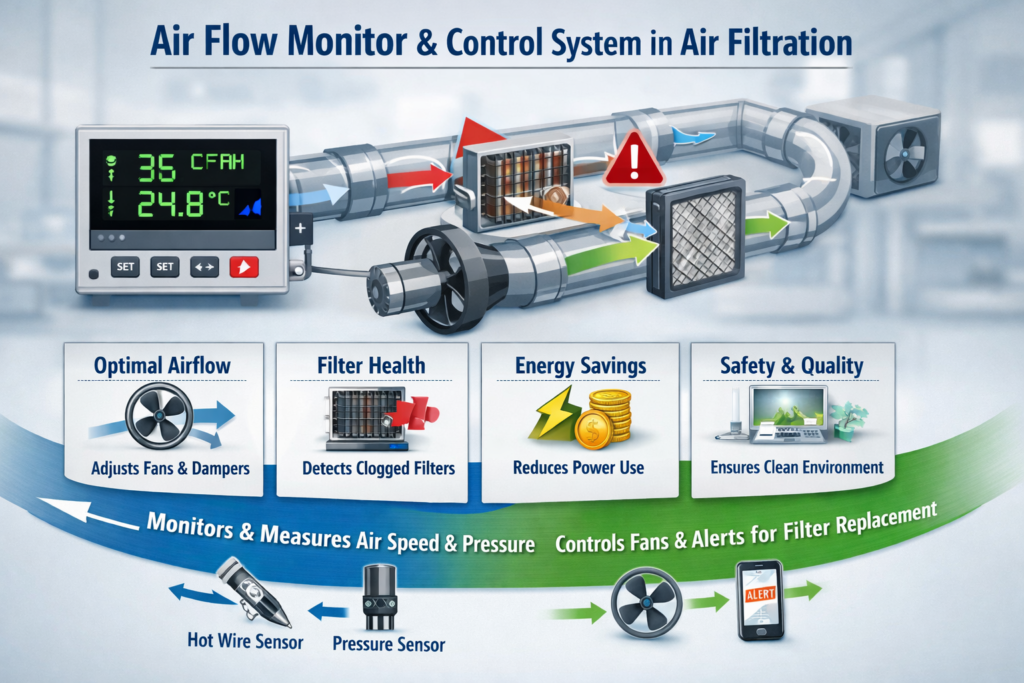
- Air filtration systems
- Building automation systems
Key Features and Technology
- Precision airflow sensing
- Real-time airflow range display (CFM)
- Temperature and humidity monitoring
- Data logging capability
- SMS, email, and sound alarm alerts
- Customizable configuration options
- Relay activation for damper control
Advantages and Disadvantages
Advantages
- Prevents equipment overheating
- Improves cooling efficiency
- Reduces energy consumption
- Provides real-time monitoring
- Supports automation integration
Disadvantages
- Initial installation cost
- Requires proper sensor placement
- Periodic calibration may be required
Operations & Functions
The airflow monitor continuously measures airflow levels and compares them with preset thresholds. If airflow drops below safe limits, the system triggers alerts and activates control mechanisms such as fans or dampers. This ensures consistent airflow and stable operating temperatures.
Key Benefits & Specifications
| Parameter | Specification |
|---|---|
| Operating Voltage | 12V / 24V / 230V AC |
| Operating Temperature | -20°C to 60°C |
| Measurement Range | 0–50 m/s |
| Accuracy | ±2–3% |
| Output Signals | 4–20 mA / 0–10 V / RS485 |
| Sensor Types | Thermal, Vane, Differential Pressure |
These specifications make the system suitable for demanding environments such as data centers.
Examples of Air flow Monitoring in Data Centers
Example 1:
If a cable bundle blocks airflow beneath a raised floor, the system detects reduced airflow and sends an alert before servers overheat.
Example 2:
If cooling demand decreases during low server loads, airflow monitoring allows HVAC units to slow down, reducing energy costs.
Example 3:
When hot air mixes with cold aisle airflow, the system detects the imbalance and adjusts dampers to maintain optimal airflow.
Connect With Kathir Sudhir Automation for Advanced Air flow Monitoring Solutions
Reliable airflow monitoring is essential for maintaining efficient cooling and preventing downtime in critical facilities. Kathir Sudhir Automation provides advanced Air Flow Monitor & Control Systems designed to deliver precise airflow measurement, automated control, and real-time monitoring capabilities.
Our solutions help data centers and industrial facilities maintain optimal airflow conditions while improving energy efficiency and system reliability. If you are planning to upgrade your HVAC monitoring infrastructure or install an airflow control system in your facility, our team can help you implement the right solution tailored to your requirements.
Conclusion
Airflow monitoring and control systems are vital for maintaining efficient cooling in modern data centers. By continuously measuring airflow and adjusting ventilation systems automatically, these technologies prevent overheating, reduce energy consumption, and improve equipment reliability. As data centers continue to grow in size and complexity, implementing advanced airflow monitoring solutions will remain essential for ensuring safe and efficient operations.
FAQ
1. What is an air flow monitoring system in data centers?
An airflow monitoring system measures the movement of air within HVAC ducts or cooling zones to ensure servers receive sufficient cooling and operate within safe temperature limits.
2. Why is air flow monitoring important for data center cooling?
It helps prevent overheating, ensures proper air distribution, and optimizes energy consumption by controlling cooling systems based on real-time airflow conditions.
3. What sensors are used for air flow monitoring?
Common sensors include thermal airflow sensors, vane sensors, and differential pressure sensors.
4. How does air flow monitoring improve energy efficiency?
It allows cooling systems to operate only when needed, reducing unnecessary fan speeds and minimizing energy consumption.
5. What happens if air flow is insufficient in a data center?
Insufficient airflow can cause server overheating, equipment failure, and potential downtime.
6. Can airflow monitoring systems integrate with building automation systems?
Yes, most modern systems support communication protocols that allow integration with BAS for centralized monitoring.
7. What is thermal dispersion airflow sensing?
It is a technology that measures airflow by detecting how heat dissipates from a heated sensor probe as air passes over it.
8. Where should airflow sensors be installed in a data center?
They are typically installed in HVAC ducts, raised floor plenums, cold aisles, and return air ducts.
9. What is the typical accuracy of airflow monitoring systems?
High-quality airflow monitoring systems offer accuracy of around ±2–3%.
10. How do airflow monitoring systems prevent downtime?
They detect airflow problems early and trigger alerts or automated control actions before equipment overheating occurs.
Related Article:
Innovative AIR FLOW CONTROL SYSTEM in the Building Automation Systems
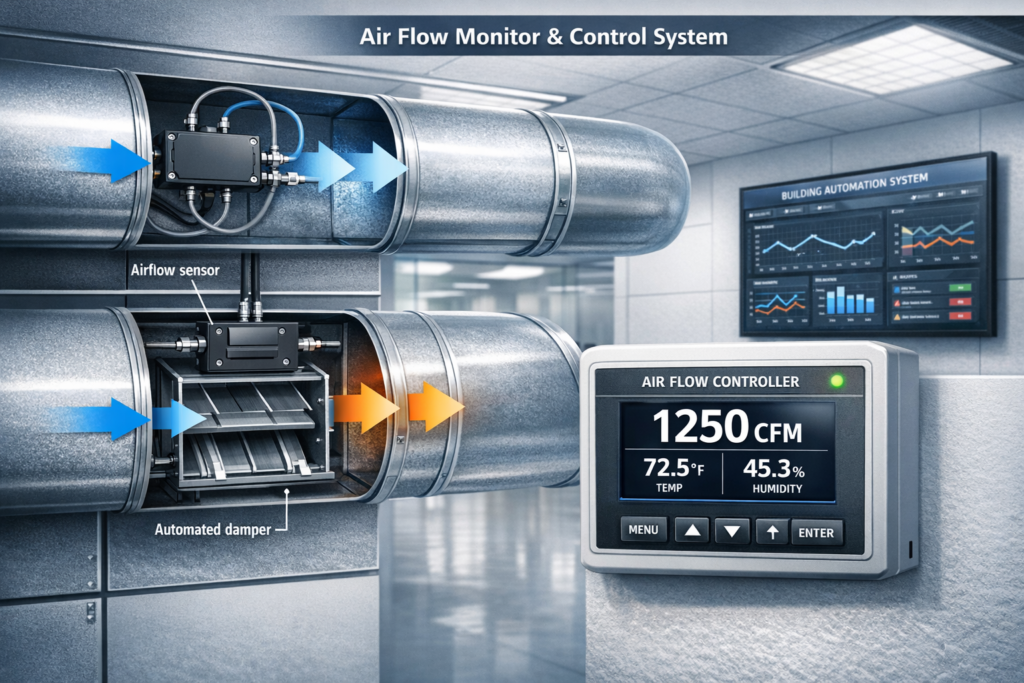
In modern buildings, managing air flow is no longer just about comfort—it’s about health, energy efficiency, and compliance. An Air Flow Monitor & Control System within a Building Automation System (BAS) continuously measures, analyzes, and regulates air movement to maintain optimal Indoor Air Quality (IAQ)…..

Kathir Sudhir Automation India specializes in advanced motion control systems, industrial automation solutions, and medical-grade linear actuator technologies for healthcare and rehabilitation equipment manufacturers.
With recognized industry certifications and multiple awards for innovation in automation systems, the company delivers reliable, high-performance electromechanical solutions tailored for medical and industrial applications.
Certifications & Recognition
Zed Bronze Certificate
Member at Confederation of Indian Industry (CII)
TANSTIA Member Certificate