
In modern industrial environments, automation is becoming essential for improving efficiency, safety, and reliability. One area where automation provides significant benefits is in heavy refrigeration and cold storage door systems. These doors are often large, insulated, and heavy, making manual operation difficult and inefficient.
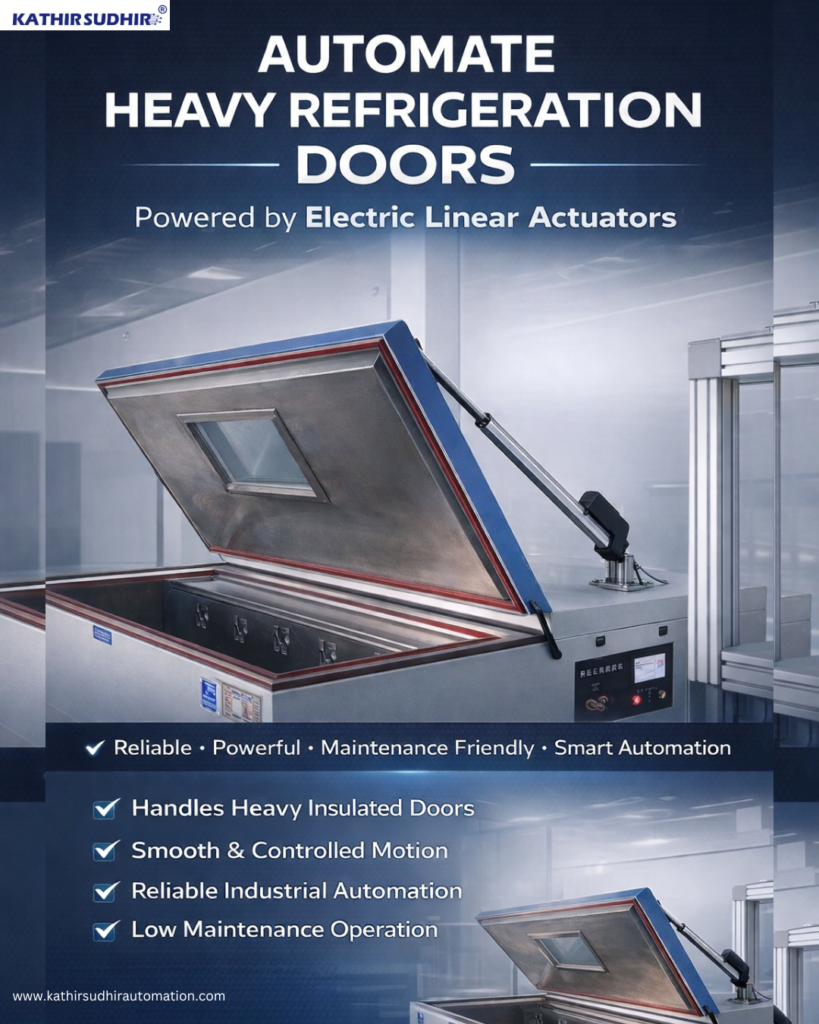
By integrating electric linear actuators, refrigeration doors can be automated to open and close smoothly, improving both operational efficiency and workplace safety.
The Challenge with Manual Refrigeration Doors
Refrigeration chambers, cold storage units, and food processing facilities often use thick insulated doors designed to maintain temperature stability. While these doors are necessary for maintaining cooling efficiency, they can be challenging to operate manually.
Common challenges include:
- Heavy door weight due to thick insulation
- Frequent opening and closing in production environments
- Risk of operator strain or injury
- Inconsistent door sealing
- Time delays in manual operation
These challenges can slow down operations and increase maintenance issues over time.
The Role of Electric Linear Actuators
Electric linear actuators provide a smart automation solution for refrigeration door systems. A linear actuator converts electrical energy into linear motion, allowing it to push or pull mechanical components with precision and control.
When installed on refrigeration doors, the actuator controls the opening and closing movement of the door in a smooth and reliable manner.
The actuator extends to lift or open the door and retracts to close it securely.
How the Automation System Works
A typical refrigeration door automation setup includes:
- Electric linear actuator
- Mounting brackets and linkages
- Control panel or switch system
- Power supply
- Safety sensors (optional)
When the system receives a command from a switch or controller, the actuator activates and performs the required movement.
Opening Process
- The actuator extends.
- The linkage mechanism pushes the door upward or outward.
- The door opens smoothly and reaches its set position.
Closing Process
- The actuator retracts.
- The door gently returns to its closed position.
- The seal is maintained to prevent temperature loss.
The movement is controlled and consistent, ensuring reliable operation.
Benefits of Automating Refrigeration Doors
Improved Operator Safety
Heavy doors can cause strain or injury when operated manually. Automation eliminates the need for manual lifting.
Smooth and Controlled Motion
Electric linear actuators provide precise motion control, preventing sudden movements or door slamming.
Reduced Maintenance
Compared to hydraulic or pneumatic systems, electric actuators require less maintenance and fewer components.
Energy Efficiency
Proper door sealing helps maintain internal temperatures, reducing refrigeration energy loss.
Increased Productivity
Automated doors speed up workflow in facilities where doors are opened frequently.
Applications
Refrigeration door automation using linear actuators is widely used in:
- Cold storage facilities
- Food processing plants
- Pharmaceutical storage units
- Industrial refrigeration chambers
- Laboratory cold rooms
- Commercial food production environments
These industries benefit from reliable door operation and consistent temperature control.
Why Electric Actuators Are Ideal for This Application
Electric linear actuators are particularly suitable for refrigeration automation because they offer:
- High lifting force capability
- Precise position control
- Quiet operation
- Compact installation
- Reliable performance in industrial environments
Their ability to handle heavy loads while maintaining smooth motion makes them an ideal solution for insulated refrigeration doors.
Conclusion
Automating refrigeration doors with electric linear actuators is an efficient way to improve operational safety, reliability, and productivity. By replacing manual door operation with automated motion control, facilities can ensure consistent door performance while reducing physical strain on workers.
As industrial automation continues to evolve, actuator-driven systems are becoming a preferred solution for modern refrigeration infrastructure.

Kathir Sudhir Automation India specializes in advanced motion control systems, industrial automation solutions, and medical-grade linear actuator technologies for healthcare and rehabilitation equipment manufacturers.
With recognized industry certifications and multiple awards for innovation in automation systems, the company delivers reliable, high-performance electromechanical solutions tailored for medical and industrial applications.
Certifications & Recognition
Zed Bronze Certificate
Member at Confederation of Indian Industry (CII)
TANSTIA Member Certificate