
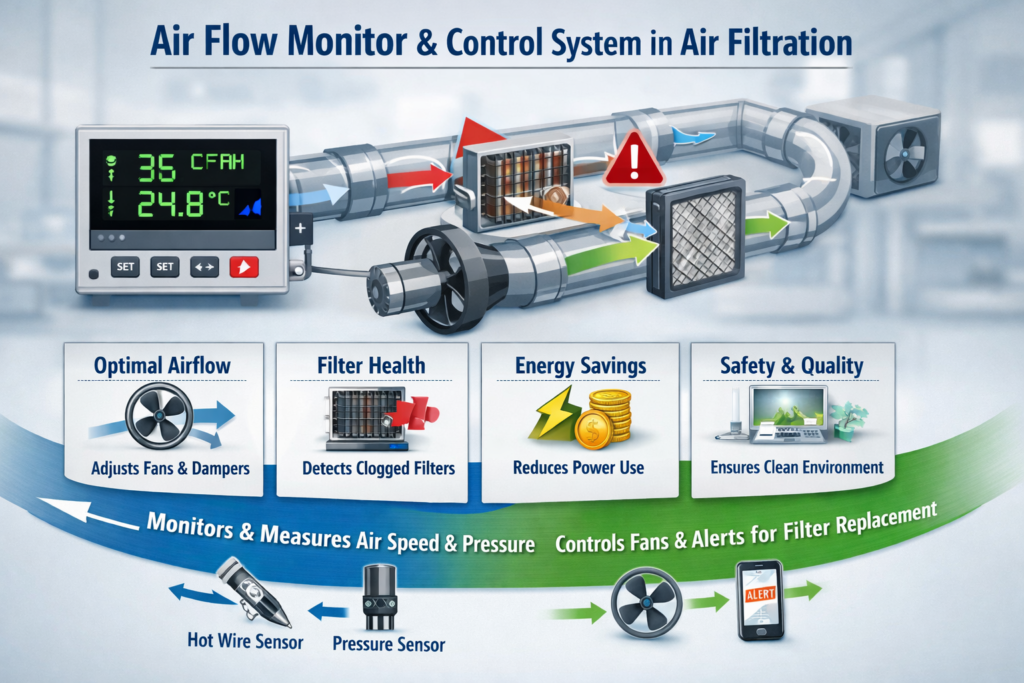
An Air Flow Monitor & Control System is a smart solution used to measure and control air movement in HVAC and filtration systems. In simple terms, it makes sure the right amount of air moves at the right speed. As a result, air quality improves and energy waste reduces. In air filtration systems, this system is especially useful because it detects airflow changes caused by dirty or clogged filters. Therefore, maintenance becomes timely and system performance stays stable.
What Is an Air Flow Monitor & Control System?
At its core, an Air Flow Monitor & Control System is an automatic airflow management tool. It measures air velocity, volume, and pressure inside ducts. Then, it compares those values with preset limits. If airflow goes outside the safe range, the system reacts instantly.
In most cases, sensors collect airflow data. After that, the controller processes the data. Finally, fans or dampers are adjusted to restore balance. Because of this closed-loop control, the system remains reliable and efficient.
How Is It Used in Air Filtration Systems?
Filter Health Monitoring
First of all, the system checks pressure before and after the filter. When dust builds up, pressure increases. As a result, the system sends an alert to replace the filter.
Maintaining Proper Airflow
Meanwhile, the system keeps airflow steady even when filters start clogging. It does this by adjusting fan speed automatically. Therefore, air delivery remains consistent.
Improving Energy Efficiency
In addition, clean filters require less fan power. So, the system slows down the fan when possible. This reduces energy use and lowers operating costs.
Safety and Contamination Control
Most importantly, in cleanrooms and pharma areas, airflow direction matters. Because of that, the system maintains positive pressure. This prevents unfiltered air from entering sensitive spaces.
Key Aspects You Should Know
- Continuous airflow measurement
- Automatic fan or damper control
- Filter blockage detection
- Real-time alerts and alarms
- Energy-saving operation
How Does an Air Flow Meter Work?
To begin with, an air flow meter detects how fast air is moving. Depending on the application, it uses different sensing methods. Once measured, the airflow value is sent to the controller. Then, corrective action is taken if required.
Because of this process, airflow stays within safe limits at all times.
Designs of Popular Mass Air Flow Sensors
Different environments need different sensor designs. Therefore, choosing the right one is important.
| Sensor Type | How It Works | Typical Use |
|---|---|---|
| Thermal (Hot-Wire) | Measures heat loss | HVAC, cleanrooms |
| Vane Type | Rotating blade detects speed | Industrial ducts |
| Differential Pressure | Uses pressure difference | Dust collectors |
Key Features and Technology
This system comes with several advanced features. For example, it displays airflow in CFM along with temperature and humidity. In addition, it allows threshold setting for alarms.
Moreover, it supports sound alerts, SMS alerts, and email notifications. Data logging is also available. Because of communication interfaces like RS485 or Modbus, system integration becomes easy. Relays further allow direct control of dampers or fans.
Required Components
To make the system work, several components are needed:
- Airflow sensor
- Controller with display
- Power supply
- Control relays
- Communication interface
- Alarm and notification unit
Together, these parts form a complete airflow control solution.
Usage: How the System Is Applied
Typically, the sensor is installed inside the duct. After installation, airflow limits are configured. Then, the system starts monitoring continuously. If airflow changes, the controller reacts immediately. As a result, system stability is maintained.
Key Application Areas
Because of its flexibility, this system is used in many industries:
- HVAC systems
- Air filtration units
- Cleanrooms and laboratories
- Fume hood systems
- Industrial ventilation
- Data centers
- Building automation
Steps to Follow for Installation
- First, study the duct size and airflow range
- Next, choose the correct sensor type
- Then, install the sensor at the right location
- After that, configure alarm thresholds
- Connect fans or dampers
- Finally, test the system thoroughly
Simple Checklist Before Operation
- Sensor installed correctly
- Power supply connected
- Threshold values set
- Alerts tested
- Communication checked
- Data logging enabled
Practical Examples
For example, in a cleanroom, the system ensures positive pressure at all times. In industrial filtration, it detects clogged dust filters early. In HVAC systems, it prevents coil freezing due to low airflow. Meanwhile, in data centers, it ensures reliable cooling airflow.
Advantages and Disadvantages
Advantages
- Better indoor air quality
- Lower energy costs
- Predictive maintenance
- Improved safety
- Longer equipment life
Disadvantages
- Initial setup cost
- Requires proper calibration
- Sensor placement affects accuracy
Comparison Table: With vs Without the System
| Parameter | With System | Without System |
|---|---|---|
| Filter Life | Longer | Shorter |
| Energy Use | Optimized | High |
| Maintenance | Planned | Reactive |
| Air Quality | Stable | Unstable |
| System Safety | High | Low |
(FAQs)
1. What is an air flow monitor and control system in HVAC applications?
It is a system that continuously measures and regulates airflow to ensure HVAC systems operate within designed limits.
2. How does an air flow control system improve air filtration efficiency?
By maintaining consistent airflow and detecting clogged filters early through pressure monitoring.
3. How do air flow management systems integrate with industrial air filters?
They connect via sensors and controllers that adjust fan speeds and trigger alerts when filters restrict airflow.
4. Which companies provide air flow monitoring solutions for air filtration systems in India?
Many industrial automation and HVAC solution providers in India offer customized airflow monitoring systems like Kathir Sudhir Automation
5. Benefits of using real-time air flow monitoring in cleanroom filtration
Maintains positive pressure, prevents contamination, and ensures regulatory compliance.
6. What are the top air flow control devices used in industrial air filtration?
Thermal airflow sensors, differential pressure transmitters, and smart controllers.
7. Types of sensors used in air flow control for dust collection systems
Differential pressure sensors and vane-type airflow sensors are commonly used.
8. Where can I buy air flow monitoring equipment for air purifiers?
From industrial automation suppliers, HVAC solution providers, and filtration system manufacturers like kathir Sudhir Automation.
9. Where to find suppliers of air flow monitoring equipment in India?
Through industrial automation distributors, HVAC integrators, and B2B marketplaces.
10. Compare smart ventilation systems for improved air purifier effectiveness
Smart systems offer real-time monitoring, automatic control, alerts, and data logging—unlike manual systems.
Conclusion
In conclusion, an Air Flow Monitor & Control System plays a vital role in modern air filtration systems. It ensures clean air, saves energy, and prevents failures. More importantly, it supports safety and compliance in critical environments. Therefore, for any filtration or HVAC setup, this system is a smart and future-ready investment.

Kathir Sudhir Automation India specializes in advanced motion control systems, industrial automation solutions, and medical-grade linear actuator technologies for healthcare and rehabilitation equipment manufacturers.
With recognized industry certifications and multiple awards for innovation in automation systems, the company delivers reliable, high-performance electromechanical solutions tailored for medical and industrial applications.
Certifications & Recognition
Zed Bronze Certificate
Member at Confederation of Indian Industry (CII)
TANSTIA Member Certificate