
Industrial facilities are constantly challenged by dust emissions, airborne contaminants, and environmental compliance requirements. A Fog Curtain System with Linear Actuators offers a smart and automated way to control these issues while improving workplace safety and operational efficiency.
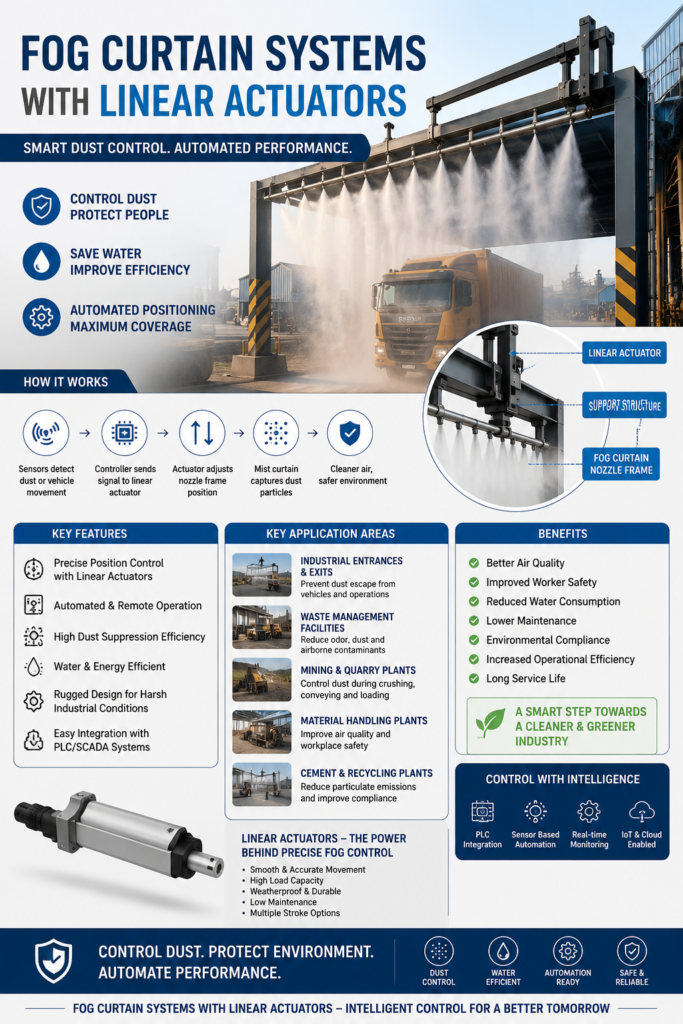
By combining precision motion control with advanced mist generation technology, these systems create a highly effective barrier that suppresses dust, reduces pollution, and enhances visibility in demanding industrial environments.
Overview of Fog Curtain Systems with Linear Actuators
A Fog Curtain System is designed to generate a fine mist curtain that acts as a barrier against airborne particles, dust, odors, and contaminants. The integration of a Linear Actuator allows automatic adjustment of the fog curtain’s position for maximum coverage and efficiency.
Key Aspects
- Automated positioning of fog curtain nozzles
- Improved dust suppression performance
- Reduced water consumption
- Remote monitoring and control
- Easy integration with PLC and automation systems
- Suitable for harsh industrial environments
Visual Suggestion
Image: Fog Curtain System installed at an industrial entrance with a linear actuator controlling the nozzle frame.
What is a Linear Actuator in a Fog Curtain System?
A linear actuator is an electromechanical device that converts rotational motion into straight-line movement.
Location
The actuator is typically installed:
Between the support structure and the fog curtain nozzle frame
Primary Functions
- Raise the fog curtain assembly
- Lower the nozzle frame
- Adjust spray angle and coverage
- Enable automated operation
- Support sensor-based positioning
How Fog Curtain Systems Work
Step 1: Detection
Sensors detect dust levels, vehicle movement, or environmental conditions.
Step 2: Control Signal
The PLC or controller sends a signal to the linear actuator.
Step 3: Position Adjustment
The actuator raises or lowers the nozzle frame.
Step 4: Mist Generation
High-pressure nozzles create ultra-fine water droplets.
Step 5: Dust Suppression
Dust particles combine with water droplets and settle quickly.
Step 6: Continuous Monitoring
The system automatically adjusts according to changing conditions.
Required Components
Mechanical Components
- Support structure
- Fog curtain nozzle frame
- Linear actuator
- Mounting brackets
- Guide rails
Electrical Components
- Actuator controller
- PLC
- Power supply
- Sensors
- Safety switches
Water System Components
- Water pump
- Filtration unit
- Piping network
- Mist nozzles
- Pressure regulator
Key Features
Precision Positioning
Provides accurate movement for optimized fog coverage.
Automation Ready
Supports PLC, SCADA, and IoT integration.
Energy Efficient
Consumes power only during movement.
Rugged Construction
Suitable for dust, moisture, and outdoor environments.
Low Maintenance
Minimal moving parts reduce maintenance requirements.
Comparison Table: Manual vs Automated Fog Curtain Systems
| Feature | Manual System | Fog Curtain with Linear Actuator |
|---|---|---|
| Position Adjustment | Manual | Automatic |
| Accuracy | Moderate | High |
| Water Efficiency | Medium | High |
| Safety | Medium | High |
| Remote Control | No | Yes |
| Integration with PLC | Limited | Excellent |
| Maintenance | Moderate | Low |
Key Application Areas and Reasons
Industrial Entrances and Exits
Reason:
Prevent dust from escaping into surrounding areas.
Waste Management Facilities
Reason:
Reduce odors and airborne particles.
Mining Operations
Reason:
Control dust generated during crushing and transportation.
Material Handling Plants
Reason:
Improve worker visibility and safety.
Cement Manufacturing
Reason:
Reduce particulate emissions.
Recycling Facilities
Reason:
Control airborne contaminants and improve air quality.
Visual Suggestion
Image: Fog curtain system operating at a mining conveyor transfer point.
Operations and Functions
Automatic Height Adjustment
Actuator changes the fog curtain position based on operational needs.
Adaptive Coverage
System adjusts mist coverage according to environmental conditions.
Dust Suppression
Captures airborne dust before it spreads.
Environmental Protection
Reduces emissions and improves air quality.
Safety Enhancement
Improves visibility for workers and vehicle operators.
Advantages and Disadvantages
Advantages
✔ Automated operation
✔ Improved dust control
✔ Reduced water usage
✔ Better workplace safety
✔ Easy integration with industrial automation
✔ Lower operating costs
✔ Increased equipment lifespan
Disadvantages
✖ Higher initial investment
✖ Requires electrical infrastructure
✖ Sensor calibration may be necessary
✖ Periodic maintenance required
Key Benefits and Specifications
Benefits
- Better environmental compliance
- Increased worker safety
- Reduced maintenance costs
- Improved operational efficiency
- Enhanced dust control performance
Typical Specifications
| Parameter | Typical Value |
| Actuator Stroke | 100–1000 mm |
| Load Capacity | 100–5000 N |
| Operating Voltage | 12V / 24V / 230V |
| Protection Rating | IP65 – IP67 |
| Operating Temperature | -20°C to +70°C |
| Control Interface | PLC / SCADA |
Key Prevention Techniques
To maximize system performance:
- Clean nozzles regularly
- Monitor water quality
- Inspect actuator mounting points
- Verify sensor calibration
- Check electrical connections
- Maintain proper water pressure
Compliance and Best Practices
Follow Local Environmental Regulations
Ensure compliance with dust and air-quality standards.
Use Quality Components
Select industrial-grade actuators and controllers.
Conduct Routine Inspections
Prevent unexpected failures.
Implement Preventive Maintenance
Schedule regular maintenance intervals.
Train Operators
Ensure safe and efficient system operation.
Technology Trends
IoT-Based Monitoring
Real-time performance monitoring through cloud platforms.
Smart Sensors
Automatic adjustment based on dust concentration.
AI-Based Control Systems
Predictive operation and optimization.
Energy-Efficient Actuators
Reduced power consumption with advanced motor technology.
Industry 4.0 Integration
Seamless communication with factory automation systems.
Step-by-Step Implementation Checklist
Planning
☐ Identify dust-generating locations
☐ Define coverage area
☐ Determine actuator stroke length
Design
☐ Select nozzle arrangement
☐ Choose actuator capacity
☐ Design support structure
Installation
☐ Install frame
☐ Mount actuator
☐ Connect water system
☐ Configure control system
Testing
☐ Verify movement
☐ Test mist coverage
☐ Validate safety functions
☐ Perform performance checks
Related Articles
For more industrial automation solutions, explore:
- https://www.kathirsudhirautomation.com/
- https://www.kathirsudhirautomation.com/linear-actuator/
- https://www.kathirsudhirautomation.com/electric-linear-actuator/
- https://www.kathirsudhirautomation.com/industrial-automation/
- https://www.kathirsudhirautomation.com/automation-solutions/
Frequently Asked Questions (People Also Ask)
1. What is a fog curtain system?
A fog curtain system creates a fine mist barrier that suppresses dust, odors, and airborne contaminants.
2. Why are linear actuators used in fog curtain systems?
They provide precise movement and positioning of the fog curtain for better coverage and automation.
3. How does a fog curtain reduce dust?
Water droplets capture dust particles and cause them to settle before spreading.
4. Can fog curtain systems be automated?
Yes. They can be integrated with PLCs, sensors, and SCADA systems for fully automatic operation.
5. What industries use fog curtain systems?
Mining, waste management, cement plants, recycling facilities, warehouses, and material handling operations.
6. What maintenance is required?
Regular nozzle cleaning, actuator inspection, water filtration maintenance, and sensor calibration.
7. Are linear actuators energy efficient?
Yes. They consume power only when moving and require minimal maintenance.
8. Can fog curtain systems operate outdoors?
Yes. Industrial systems are designed for outdoor and harsh environmental conditions.
9. What is the lifespan of a linear actuator?
Depending on usage and maintenance, industrial actuators can operate reliably for many years.
10. How do I select the right actuator?
Consider load capacity, stroke length, speed, duty cycle, environmental conditions, and control requirements.
Conclusion
Fog Curtain Systems with Linear Actuators provide an advanced and reliable solution for industrial dust suppression, environmental management, and workplace safety. Their ability to automatically position the fog curtain, optimize water usage, and integrate with modern automation platforms makes them a valuable investment for industries seeking cleaner operations and improved compliance. As industrial facilities continue adopting Industry 4.0 technologies, actuator-controlled fog curtain systems will play an increasingly important role in creating safer, smarter, and more sustainable workplaces.
Installation Location
The linear actuator is typically mounted between the support structure and the fog curtain nozzle frame, allowing smooth vertical movement and precise positioning of the fog curtain.
Benefits of Using Linear Actuators in Fog Curtain Systems
1. Precise Position Control
Linear actuators provide accurate movement, ensuring the fog curtain is positioned at the ideal height and angle for maximum effectiveness.
2. Automation and Remote Operation
The actuator can be integrated with PLCs, sensors, and industrial control systems, allowing automatic adjustments based on environmental conditions.
3. Enhanced Operational Efficiency
By positioning the fog curtain only where needed, water consumption and energy usage can be optimized.
4. Improved Safety
Automated positioning reduces manual intervention, improving worker safety in hazardous industrial environments.
5. Long Service Life
Industrial-grade actuators are designed to withstand harsh conditions such as dust, moisture, and vibration.
Industrial Applications
Fog Curtain Systems equipped with linear actuators are widely used in:
Industrial Entrances and Exits
Control dust and airborne particles generated by vehicle movement and material transportation.
Waste Management Facilities
Reduce odor, suppress dust, and improve environmental conditions around waste processing areas.
Mining and Material Handling Plants
Control dust emissions during crushing, conveying, and loading operations, helping facilities comply with environmental regulations.
Conclusion
Integrating a Linear Actuator into a Fog Curtain System provides intelligent positioning, automated operation, and improved performance. Whether used in industrial entrances, waste management facilities, or mining operations, actuator-controlled fog curtains help create safer, cleaner, and more efficient working environments.

Kathir Sudhir Automation India specializes in advanced motion control systems, industrial automation solutions, and medical-grade linear actuator technologies for healthcare and rehabilitation equipment manufacturers.
With recognized industry certifications and multiple awards for innovation in automation systems, the company delivers reliable, high-performance electromechanical solutions tailored for medical and industrial applications.
Certifications & Recognition
Zed Bronze Certificate
Member at Confederation of Indian Industry (CII)
TANSTIA Member Certificate