
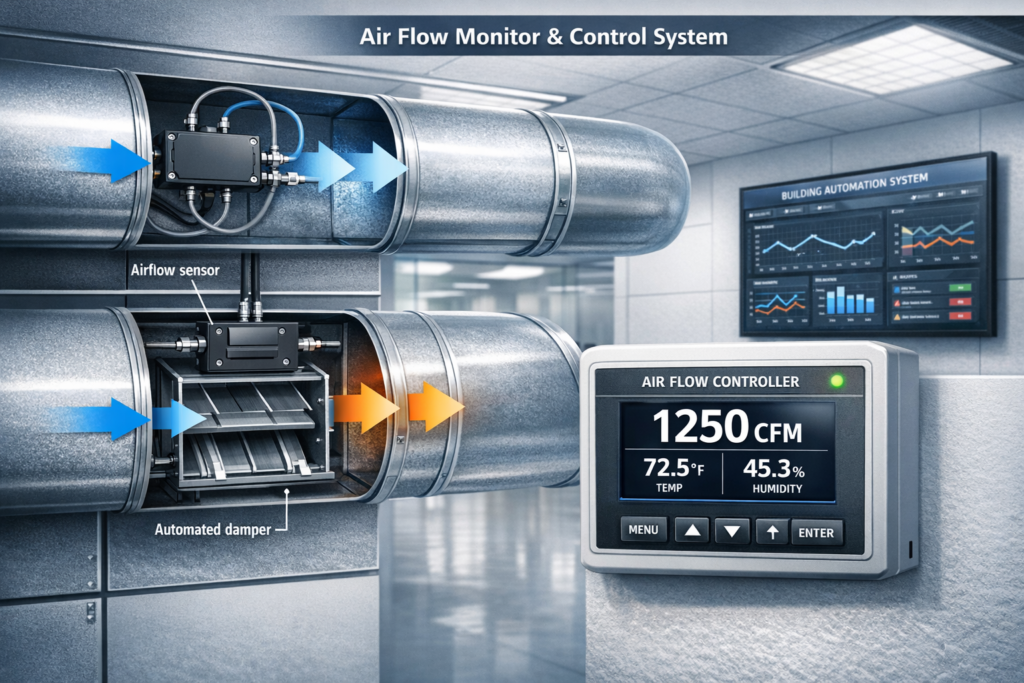
In modern buildings, managing air flow is no longer just about comfort—it’s about health, energy efficiency, and compliance. An Air Flow Monitor & Control System within a Building Automation System (BAS) continuously measures, analyzes, and regulates air movement to maintain optimal Indoor Air Quality (IAQ). Based on the referenced product, this system combines precise sensing, smart control, and real-time alerts to help facility teams run safer and more efficient buildings. It’s a practical solution designed for real-world HVAC, laboratory, clean room, and commercial building challenges.
Regulations and IAQ Monitoring
- Increasing IAQ regulations demand continuous monitoring of ventilation rates.
- Air flow monitoring helps meet HVAC, laboratory, and workplace safety standards.
- Automated alerts ensure quick action before non-compliance becomes a risk.
What Is a Building Automation System?
A Building Automation System (BAS) is a centralized platform that:
Monitors HVAC, lighting, energy, and safety system. Uses sensors, controllers, and communication protocols. Optimizes comfort, efficiency, and operational reliability
Do You Know What Type of BAS You Have?
- Standalone BAS – Limited automation, minimal data integration
- Networked BAS – Central monitoring with basic analytics
- Smart / Integrated BAS – Real-time data, historical logging, advanced controls
Knowing your BAS type helps determine how easily an air flow control system can be integrated.
Controlling IAQ On-Demand
Real-time airflow data (CFM / m/s). Automatic damper and fan adjustments. Demand-based ventilation instead of fixed schedules
Getting Particular About IAQ Status
- Live display of airflow, temperature, and humidity
- Threshold-based status indicators
- Alerts when airflow deviates from safe limits
Benefits of IAQ Monitors for Facility Managers
Reduced manual inspections. Faster fault detection (dirty filters, fan failure). Better tenant comfort and productivity
Instant Air Quality Analysis
- High-precision sensors deliver immediate feedback
- Data logging enables trend analysis
- Supports proactive maintenance strategies
Work Smarter, Not Harder
Automation replaces manual airflow balancing. Integrated alerts reduce response time. One system manages monitoring, control, and reporting.
Key Features and Technology
- Thermal, vane, or differential pressure sensors (application-based)
- Digital display for airflow, temperature, humidity, and thresholds
- Sound alarm, SMS, and e-mail alert options
- RS485 / Modbus communication for BAS integration
- Relay outputs for damper and actuator control
Required Components & Functions
Components
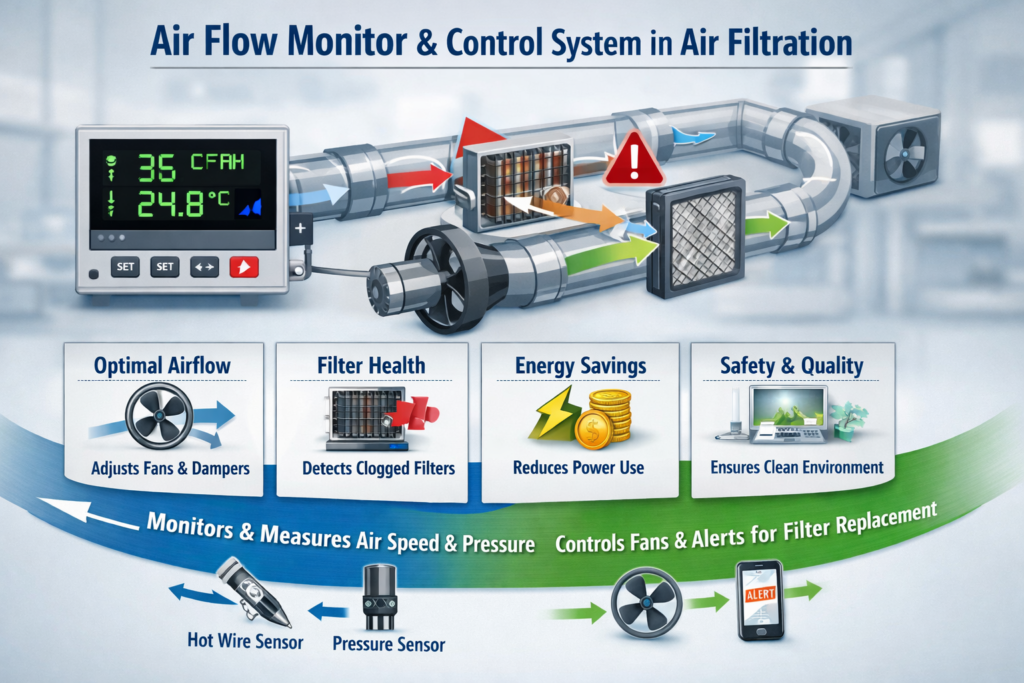
- Air flow sensor
- Controller / display unit
- Actuators or dampers
- Communication interface
- Power supply
Functions
- Measurement & monitoring
- Automated control
- Data integration
- Safety alarms
How It Is Used
Installed in ducts or ventilation lines. Measures real-time air velocity and volume. Sends data to BAS. Adjusts fans, dampers, or VFDs automatically
Key Application Areas
- Commercial HVAC systems
- Laboratories and clean rooms
- Data centers
- Industrial ventilation
- Fume hood systems
- Building automation projects
Comparison Table: Sensor Technologies
| Sensor Type | Accuracy | Best Use Case | Cost Level |
|---|---|---|---|
| Thermal | High | Low air velocity, IAQ | Medium |
| Vane | Medium | Large ducts | Low |
| Differential Pressure | Very High | Critical environments | High |
Key Aspects
- Real-time monitoring
- Automation-ready design
- Energy optimization
- Compliance support
Advantages and Disadvantages
Advantages
- 20–40% potential energy savings
- Improved IAQ and occupant comfort
- Reduced manual intervention
Disadvantages
- Initial installation cost
- Requires BAS compatibility planning
Key Benefits & Specifications
- Measurement range: configurable up to 0–50 m/s
- Accuracy: ±2–3% of reading
- Outputs: 4–20 mA, 0–10 V, RS485/Modbus
- Operating voltage: 12V / 24V / 230V AC
- Operating temperature: –20°C to 60°C
Steps to Follow (Implementation)
- Assess existing BAS compatibility
- Identify critical airflow zones
- Select suitable sensor technology
- Install and calibrate sensors
- Integrate with BAS
- Configure alerts and thresholds
Checklist for You
☐ BAS communication protocol confirmed
☐ Sensor type selected
☐ Alarm and notification settings enabled
☐ Data logging configured
☐ Maintenance plan defined
Examples
- Office Building: Demand-controlled ventilation reduces energy bills
- Laboratory: Continuous airflow compliance for safety
- Data Center: Stable airflow prevents overheating
FAQs
- Best air flow monitor and control systems for building automation in India?
Systems with Modbus/RS485 support, multiple sensor options, and alert features are ideal for Indian BAS projects. - What are the essential components of an air flow monitoring system for commercial buildings?
Sensors, controllers, actuators, communication modules, and a BAS interface. - How to integrate air flow control devices into existing building automation systems?
By matching communication protocols and configuring control logic within the BAS. - Compare different air flow sensor technologies for HVAC systems in India.
Thermal sensors suit IAQ, vane sensors fit large ducts, and differential pressure sensors serve critical zones. - Top suppliers of air flow monitoring instruments for smart buildings in India?
Look for suppliers offering customization, local support, and BAS-ready devices. - Where can I find suppliers of VAV air handling units for building automation in Mumbai?
HVAC system integrators and BAS solution providers typically handle VAV sourcing. - Compare features of popular air flow sensors used in building automation.
Key differences lie in accuracy, response time, and environmental suitability. - Request a quote for installing an integrated air flow control system in a new office complex.
Provide duct layout, BAS type, and monitoring requirements to suppliers. - Where to buy air flow controllers compatible with major building automation platforms?
Choose controllers with open protocols like Modbus and flexible I/O options. - How do intelligent air flow controls contribute to energy savings in large facilities?
By optimizing fan speeds and ventilation rates based on real-time demand.
Conclusion
An Air Flow Monitor & Control System is a core building block of modern Building Automation Systems. By combining precise measurement, automated control, and intelligent alerts, it enhances IAQ, ensures compliance, and delivers measurable energy savings. For facility managers and system integrators, it’s a smart investment that supports safer, healthier, and more efficient buildings—today and well into the future.
Related Articles:
Powerful Air Flow Monitor for Clean Rooms: Working and Applications
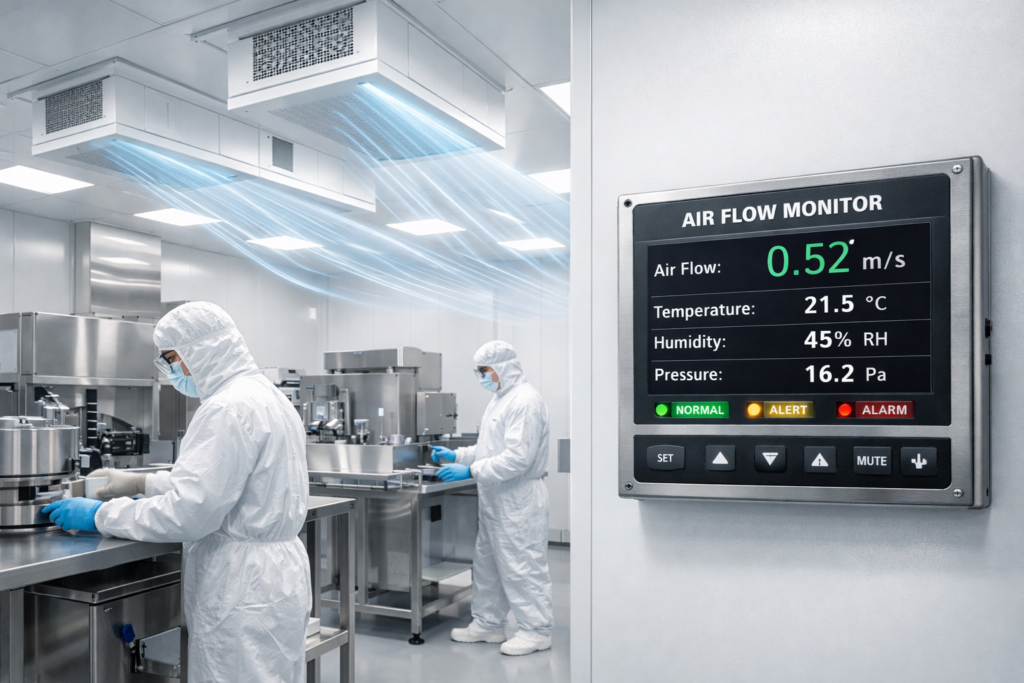
Cleanrooms are engineered environments where even microscopic contamination can compromise product quality, safety, and compliance. Whether in pharmaceutical manufacturing, electronics assembly, laboratories, or medical device production, controlled airflow is the backbone of cleanroom performance.
How Laboratories Use the Powerful Air Flow Control Systems?
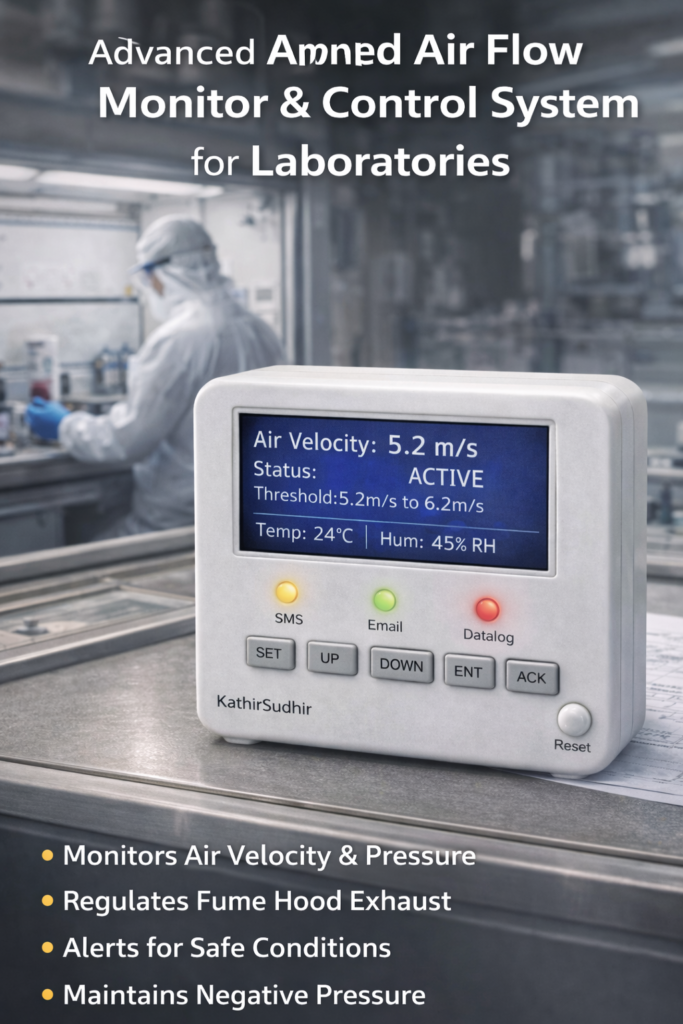
Laboratories must stay safe at all times. They handlhttps://www.kathirsudhirautomation.com/how-laboratories-use-air-flow-control-systemse chemicals, gases, and sensitive samples. Because of this, airflow control is very important. If airflow is poor, harmful fumes can spread.

Kathir Sudhir Automation India specializes in advanced motion control systems, industrial automation solutions, and medical-grade linear actuator technologies for healthcare and rehabilitation equipment manufacturers.
With recognized industry certifications and multiple awards for innovation in automation systems, the company delivers reliable, high-performance electromechanical solutions tailored for medical and industrial applications.
Certifications & Recognition
Zed Bronze Certificate
Member at Confederation of Indian Industry (CII)
TANSTIA Member Certificate