
What is a Dual Axis Solar Tracker?
A dual axis solar tracker is a mechanical system that automatically adjusts solar panels in two directions:
- Azimuth (Horizontal Rotation) – East to West sun movement
- Elevation (Vertical Tilt) – Seasonal North to South sun shift
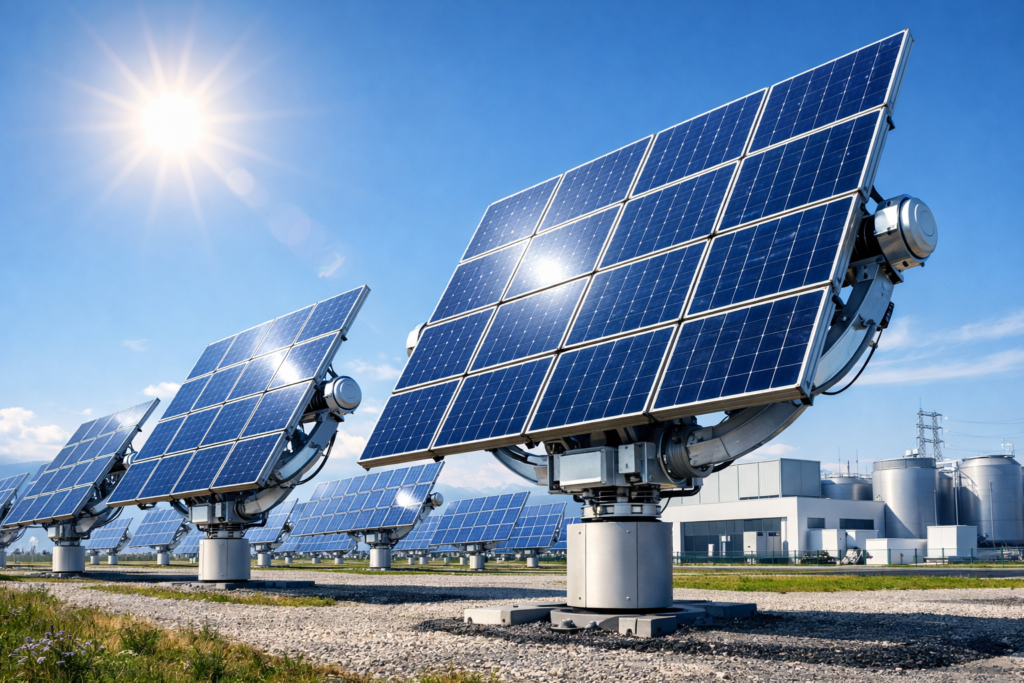
Technical Overview
| Parameter | Specification |
|---|---|
| Tracking Range | Azimuth: 0°–270° (360° optional) |
| Drive Mechanism | Linear actuators or slew drive motors |
| Control System | LDR sensors or GPS-based tracking |
| Power Supply | 12V / 24V DC, AC supply, or self-powered |
| Capacity | 1kW – 20kW per tracker (customizable) |
These systems are engineered with durable structures, easy installation (no complex wiring), and weather adaptability to ensure long-term performance.
How Does a Dual Axis Solar Tracking System Work?
A dual-axis tracker continuously monitors the sun’s position and adjusts panel orientation accordingly:
- Sun Position Detection – LDR sensors or GPS determine solar location.
- Microcontroller Processing – Controllers (Arduino, NodeMCU, etc.) analyze data.
- Motor Activation – Linear actuators or motors adjust azimuth and elevation.
- Perpendicular Alignment – Panels maintain near 90° sunlight angle.
- Continuous Optimization – Automatic correction throughout the day and across seasons.
This dynamic adjustment ensures maximum solar irradiance absorption.
The Astronomical Tracking Algorithm
Modern systems often use an astronomical tracking algorithm, which calculates the sun’s position based on:
- Geographic coordinates
- Date and time
- Solar declination
- Hour angle
Unlike sensor-based systems, algorithm-based trackers are highly accurate even during cloudy conditions since they rely on mathematical solar models rather than light detection alone.
Single-Axis vs Dual Axis Solar Trackers: What’s the Difference?
| Feature | Fixed Tilt | Single-Axis | Dual-Axis |
|---|---|---|---|
| Movement | None | East-West | East-West + North-South |
| Energy Gain | Baseline | +15–25% | Up to +40% |
| Cost | Low | Medium | High |
| Maintenance | Low | Moderate | Higher |
| Best For | Rooftops | Utility farms | High-efficiency plants |
Dual-axis trackers deliver the highest output but involve greater mechanical complexity.
Key Features
- Two-Axis Movement
- Higher Energy Output
- Automated Smart Control
- Weather-Resistant Structure
- Easy Installation
- Customizable Capacity (1kW–20kW)
What Are the Benefits of Dual Axis Solar Tracking Systems?
1. Maximum Energy Production
Up to 40% more electricity compared to fixed systems.
2. Higher Power Density
More energy generated per square meter.
3. Seasonal Optimization
Performs exceptionally well in varying sun angles.
4. Ideal for High-Latitude Regions
Maximizes low-angle winter sunlight capture.
5. Commercial ROI Advantage
Higher yield translates to faster return on investment in solar power plants.
What Are the Disadvantages of a Dual Axis Solar Tracker?
- Higher initial installation cost
- Increased maintenance due to moving components
- Heavier structure (less suitable for rooftops)
- Requires proper structural foundation
Despite these factors, for large-scale ground-mounted plants, the benefits often outweigh the drawbacks.
Is a Dual Axis Solar Tracking System a Worthy Investment?
For solar power plants and commercial installations, yes.
Although the upfront cost is higher, the increased energy generation (up to 40%) significantly improves long-term revenue. In high solar intensity regions, the ROI period shortens due to enhanced power output and better grid utilization.
Applications and Uses for Dual Axis Solar Trackers
Solar Power Plants
Large-scale ground-mounted PV farms requiring maximum generation.
Commercial & Industrial Facilities
Factories and warehouses demanding high-efficiency systems.
Agriculture (Agrivoltaics)
Improved dual land use for farming and solar energy.
Telecommunications
Remote tower power systems.
Research & Educational Institutions
Solar labs and renewable energy research projects.
Key Aspects to Consider
- Site solar irradiation level
- Soil and foundation strength
- Wind load capacity
- Maintenance accessibility
- Grid connectivity requirements
Usage Steps for Solar Power Plants
- Site feasibility analysis
- Tracker capacity selection (1kW–20kW modules)
- Structural installation
- Electrical integration
- System calibration
- Performance testing
- Ongoing monitoring
Installation Checklist
✔ Ground leveling completed
✔ Structural anchoring verified
✔ Electrical wiring secured
✔ Controller programming configured
✔ Sensor alignment calibrated
✔ Safety compliance confirmed
Example Scenario
A 1MW solar plant using fixed-tilt panels produces X units annually. By integrating dual-axis trackers, the plant can potentially generate 30–40% additional energy, significantly improving profitability and reducing levelized cost of energy (LCOE).
FAQs
1. How much more energy does a dual-axis tracker produce?
Up to 40% more than fixed systems and 5–10% more than single-axis trackers.
2. Are dual-axis trackers suitable for rooftops?
Generally no, due to structural weight and complexity.
3. What power supply is required?
12V/24V DC, AC supply, or self-powered options.
4. What is the tracking range?
Azimuth 0°–270° (360° optional), Elevation 0°–90°.
5. Do trackers work on cloudy days?
Yes, especially GPS/algorithm-based systems.
6. What maintenance is required?
Periodic lubrication, actuator inspection, and controller checks.
7. What capacity can one tracker support?
Typically 1kW to 20kW (customizable).
8. Is it good for high-wind areas?
Yes, if designed with robust weather-resistant structures.
9. Does it improve ROI?
Yes, due to higher energy yield.
10. Is it customizable?
Yes, based on project capacity and location.
Conclusion
Dual-axis solar tracking systems represent the most efficient technology for maximizing solar power plant performance. By enabling panels to follow both daily and seasonal sun paths, they ensure optimal perpendicular sunlight absorption and significantly increase energy yield.
While they require a higher initial investment and maintenance planning, their superior efficiency, enhanced ROI potential, and adaptability make them the preferred choice for large-scale, ground-mounted solar power plants aiming for maximum power generation and long-term sustainability.

Kathir Sudhir Automation India specializes in advanced motion control systems, industrial automation solutions, and medical-grade linear actuator technologies for healthcare and rehabilitation equipment manufacturers.
With recognized industry certifications and multiple awards for innovation in automation systems, the company delivers reliable, high-performance electromechanical solutions tailored for medical and industrial applications.
Certifications & Recognition
Zed Bronze Certificate
Member at Confederation of Indian Industry (CII)
TANSTIA Member Certificate