
Cleanrooms are engineered environments where even microscopic contamination can compromise product quality, safety, and compliance. Whether in pharmaceutical manufacturing, electronics assembly, laboratories, or medical device production, controlled airflow is the backbone of cleanroom performance. An Air Flow Monitor & Control System plays a critical role by continuously measuring, analyzing, and regulating airflow parameters to maintain cleanliness, pressure balance, and regulatory compliance.
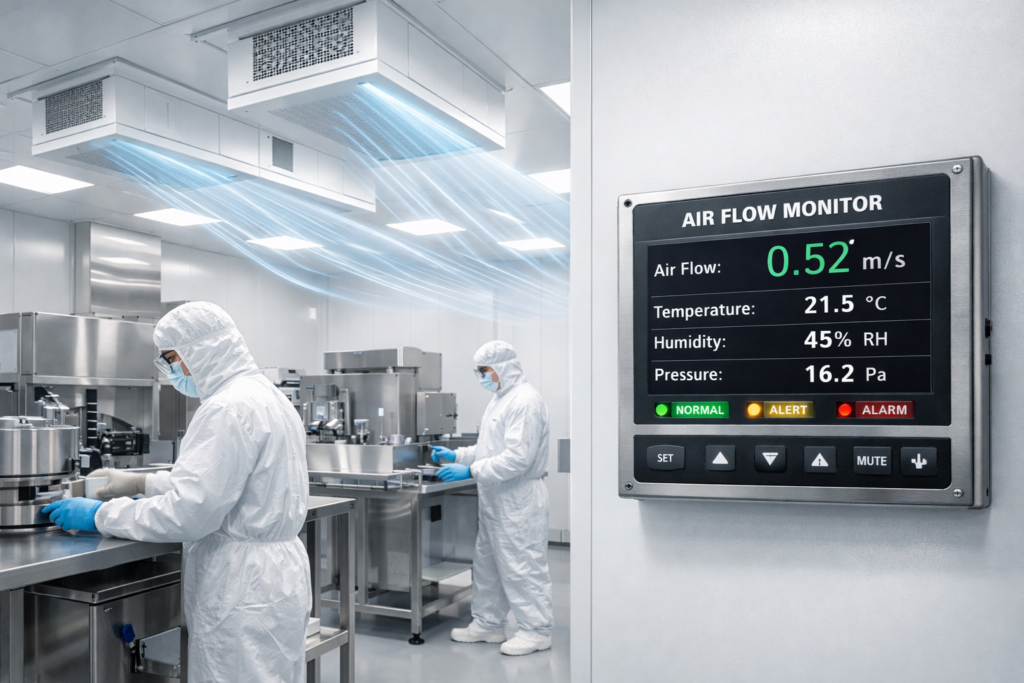
Understanding Cleanroom Air Flow Monitoring & Control
An air flow monitor and control system is an automated, high-precision setup designed to measure and regulate air velocity, air volume, temperature, humidity, and pressure within controlled environments such as cleanrooms.
In cleanroom applications, this system ensures:
- Stable laminar airflow
- Correct pressure differentials
- Consistent air change rates (ACH)
- Continuous compliance with ISO and GMP standards
By integrating sensors, controllers, alarms, and control outputs, the system actively maintains cleanroom conditions and alerts operators when deviations occur.
Core Functions of an Air Flow Monitor & Control System
1. Precision Airflow Measurement
Using thermal, vane, or differential pressure sensors, the system measures real-time airflow in ducts or open areas. Measurement accuracy typically ranges between ±2–3%, ensuring reliable monitoring.
2. Intelligent Control & Regulation
Based on live data, the system automatically adjusts:
- Dampers
- Variable Frequency Drives (VFDs)
- Air Handling Units (AHUs)
This closed-loop control maintains predefined airflow setpoints without manual intervention.
3. Advanced Alerts & Safety Interlocks
When airflow drops below or exceeds safe thresholds, the system activates:
- Audible alarms
- Visual alerts
- Optional SMS and e-mail notifications
These safety interlocks reduce contamination risk and operational downtime.
Key Components of an Air Flow Monitor & Control System
| Component | Function in Cleanroom |
|---|---|
| Airflow Sensors | Measure velocity and volume of air |
| Temperature & Humidity Sensors | Maintain environmental stability |
| Controller & Display Unit | Displays airflow (CFM), temp, humidity, thresholds |
| Control Outputs | Regulates dampers, fans, and AHUs |
| Alarm & Notification System | Alerts operators to unsafe airflow |
| Communication Interface | RS485 / Modbus for BMS integration |
Cleanroom-Specific Applications of Air Flow Monitoring Systems
1. Contamination Prevention Through Laminar Airflow
The system ensures HEPA-filtered air flows uniformly from ceiling to floor, continuously flushing airborne particles away from critical zones. This principle is widely emphasized by cleanroom authorities such as Cleanroom Industries.
2. Maintaining Pressure Differentials
Cleanrooms are kept at positive pressure relative to adjacent spaces. When doors open, clean air flows outward, preventing contaminated air ingress—an essential GMP requirement.
3. Controlling Air Change Rates (ACH)
ACH defines how many times the room’s air volume is replaced per hour. Continuous monitoring ensures the ACH remains within validated limits, preserving air quality and compliance.
4. Energy-Efficient Cleanroom Operation
Instead of constant maximum airflow, the system dynamically adjusts air volume based on real-time demand—reducing HVAC energy consumption while maintaining cleanliness.
5. HEPA FFU & Air Return Management
Cleanroom airflow control commonly involves:
- Ceiling-mounted HEPA Fan Filter Units (FFUs)
- Controlled air return paths
This method is frequently referenced in cleanroom design practices.
Key Aspects of Air Flow Monitor & Control Systems
| Aspect | Description |
|---|---|
| Real-Time Monitoring | Continuous airflow, temperature, humidity tracking |
| Automated Control | Self-adjusting airflow without manual input |
| Safety Interlocks | Immediate alerts for low or high airflow |
| Data Logging | Historical airflow records for audits |
| Custom Configurations | Adaptable for ducts or open areas |
| System Integration | Compatible with BMS & HVAC controls |
Typical Technical Specifications (Cleanroom Use)
| Parameter | Value |
|---|---|
| Operating Voltage | 12V / 24V / 230V AC |
| Airflow Range | 0–50 m/s (configurable) |
| Accuracy | ±2–3% |
| Output Signal | 4–20 mA, 0–10 V, RS485 |
| Operating Temperature | −20°C to 60°C |
| Control Output | Relay for damper / fan control |
FAQs
1. What is an air flow monitor & control system?
It is an automated system that measures and regulates airflow to maintain cleanroom conditions.
2. Why is airflow monitoring critical in cleanrooms?
Because airflow directly controls contamination, pressure balance, and ISO compliance.
3. How does airflow affect cleanroom classification?
Incorrect airflow can increase particle count, causing ISO classification failure.
4. What sensors are used in cleanroom airflow monitoring?
Thermal, vane, and differential pressure sensors.
5. What happens if airflow drops below limits?
The system triggers alarms and alerts operators immediately.
6. How does the system help meet ISO 14644 standards?
By providing continuous airflow monitoring and documented data logs.
7. Can airflow monitoring reduce energy consumption?
Yes, by optimizing HVAC operation based on real-time demand.
8. Is the system compatible with BMS?
Yes, via Modbus / RS485 communication interfaces.
9. Where are airflow monitors installed in cleanrooms?
In ducts, ceiling FFUs, air returns, or critical airflow zones.
10. Which industries require airflow monitoring systems?
Pharmaceuticals, electronics, laboratories, medical devices, and biotech.
Conclusion
An Air Flow Monitor & Control System is not just a monitoring tool—it is a critical safeguard for cleanroom integrity. By ensuring laminar airflow, pressure stability, regulatory compliance, and energy efficiency, it protects both products and processes. For industries where cleanliness equals quality, investing in a robust airflow monitoring and control solution is essential for long-term operational success.

Kathir Sudhir Automation India specializes in advanced motion control systems, industrial automation solutions, and medical-grade linear actuator technologies for healthcare and rehabilitation equipment manufacturers.
With recognized industry certifications and multiple awards for innovation in automation systems, the company delivers reliable, high-performance electromechanical solutions tailored for medical and industrial applications.
Certifications & Recognition
Zed Bronze Certificate
Member at Confederation of Indian Industry (CII)
TANSTIA Member Certificate