
Laboratories must stay safe at all times. They handle chemicals, gases, and sensitive samples. Because of this, airflow control is very important. If airflow is poor, harmful fumes can spread. Also, air can move in the wrong direction. As a result, people and experiments can be at risk. Therefore, laboratories use Air Flow Control Systems. These systems control air movement. They also help maintain safe room pressure. Most importantly, they keep harmful air inside the lab.
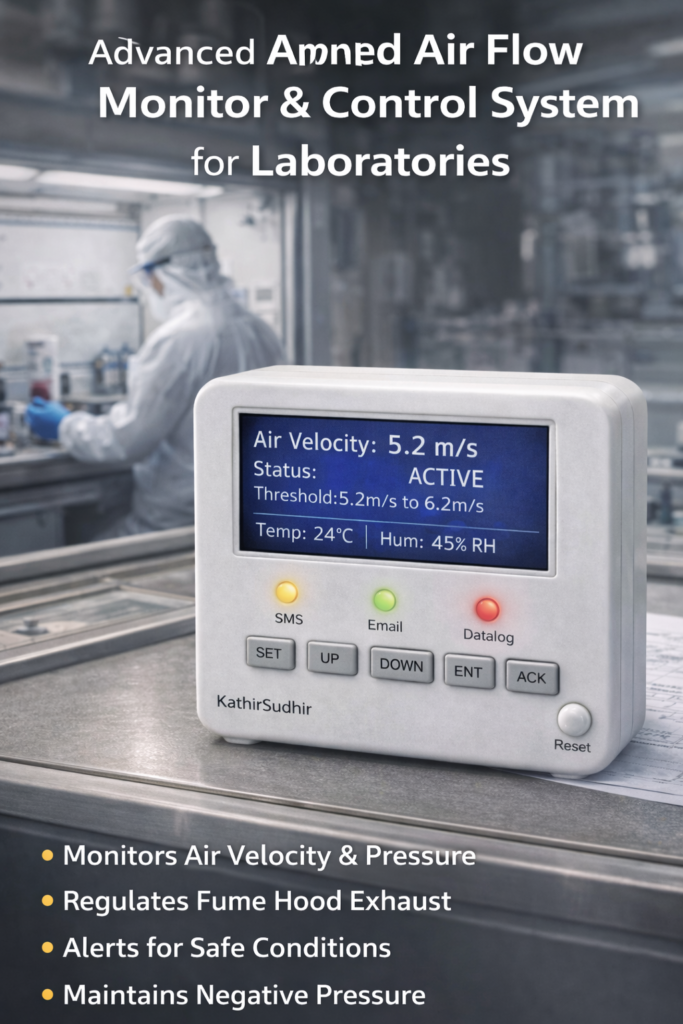
Why Airflow Control Is So Important in Laboratories
First, airflow keeps people safe. Labs must stop fumes from escaping. To do this, they keep rooms at negative pressure.
This means air flows into the lab. However, it does not flow out. Because of this, harmful air stays inside.
In addition, these systems support HVAC control. They help manage temperature and humidity. As a result, lab conditions stay stable.
Airflow monitors use sensors. These sensors measure air speed and pressure. Then, the system adjusts fans and dampers. Therefore, airflow stays within safe limits.
Simple Ways Laboratories Control Airflow
Variable Air Volume (VAV) Control
Many labs use Variable Air Volume (VAV) systems. In these systems, airflow changes based on need. For example, airflow increases when a fume hood is in use. When it is not, airflow decreases. Because of this, labs save energy. At the same time, safety remains high. VAV systems also keep fume hood air speed steady. Therefore, harmful gases are removed safely.
Airflow Direction to Stop Contamination
Another key method is airflow direction control.
Air always moves from clean areas to risky areas. This helps stop contamination. More importantly, it protects lab staff.
Even when doors open, the system reacts fast. As a result, airflow direction stays correct.
Room Pressure Control
Pressure control is also critical. Air Flow Monitor & Control Systems check pressure all the time. If pressure changes, the system responds quickly. It adjusts fans or dampers. Because of this, labs stay under negative pressure. Therefore, harmful air cannot escape.
Modern Features Used in Airflow Control Systems
Live Monitoring and Safety Alerts
These systems show airflow data in real time. They also show temperature and humidity.
If airflow drops, alarms turn on. These may be lights or sounds. As a result, users can act quickly.
Accurate Sensors for Better Control
Different sensors are used based on need. These include thermal, vane, or pressure sensors. They give accurate data. Because of this, labs can trust the readings.
Automation and Data Recording
Modern systems support automation.
They control dampers on their own. They also store data for records. In addition, they connect to building systems.
As a result, labs meet safety rules more easily.
Stable Conditions for Better Lab Results
Air flow control also helps experiments. It keeps temperature and humidity steady. Because of this, test results remain reliable. This is very important in research and clean rooms.
Conclusion
Air Flow Monitor & Control Systems are essential for laboratories.
They protect people. They stop contamination. They also save energy.
Therefore, every modern lab needs a reliable air flow control system.

Kathir Sudhir Automation India specializes in advanced motion control systems, industrial automation solutions, and medical-grade linear actuator technologies for healthcare and rehabilitation equipment manufacturers.
With recognized industry certifications and multiple awards for innovation in automation systems, the company delivers reliable, high-performance electromechanical solutions tailored for medical and industrial applications.
Certifications & Recognition
Zed Bronze Certificate
Member at Confederation of Indian Industry (CII)
TANSTIA Member Certificate