
Handling fragile materials has always been a delicate challenge in manufacturing. Whether it’s snack foods, pharmaceutical tablets, electronic components, or lightweight plastic parts, even a small amount of excess vibration can damage the product or reduce the efficiency of the line.
This is where vibratory feeder controllers play a crucial role — bringing precision, consistency, and protection to sensitive material flow.
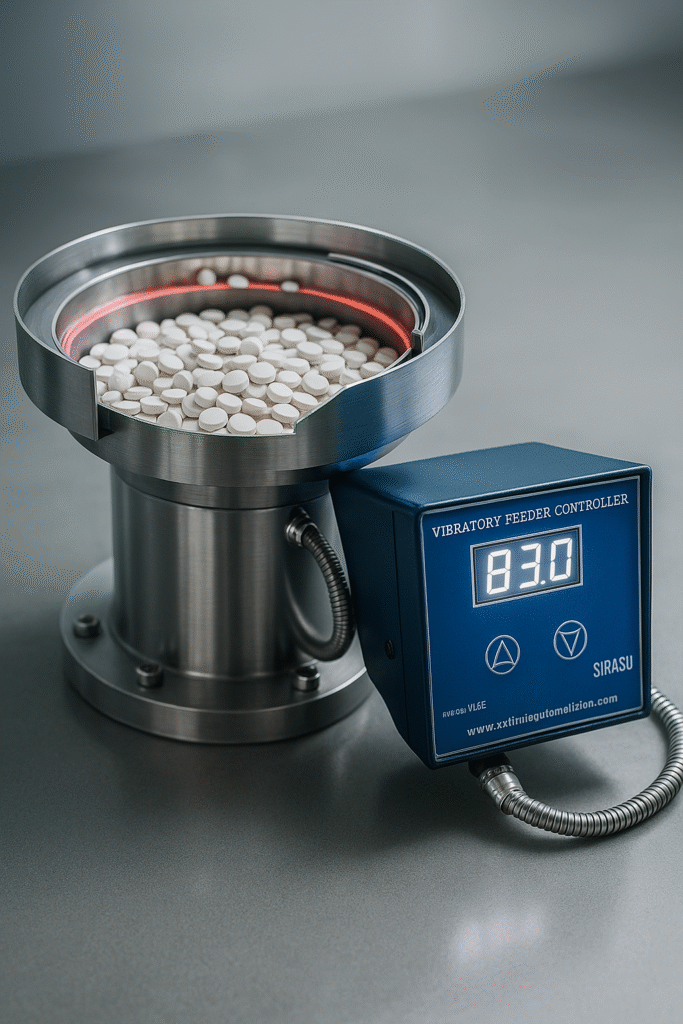
The Challenge of Fragile Material Feeding
Imagine a line filled with delicate components that must move smoothly toward the next process.
If the vibration is too high, the parts chip, break, scratch, or jam.
If it’s too low, the flow becomes inconsistent, reducing throughput.
Fragile materials demand a balance between gentle handling and steady feeding, and this balance is only possible with a smart, responsive control system.
How Vibratory Feeder Controllers Make a Difference
A vibratory feeder controller regulates the vibration frequency and amplitude of the feeder system. Instead of allowing the feeder to run at a fixed intensity, the controller adjusts the vibration precisely according to the material behavior.
1. Fine-Tuned Vibration Control
Controllers allow micro-level adjustments, ensuring materials move gradually without sudden shocks or surges.
2. Stable Feeding Without Breakage
Delicate items like ceramic parts, chips, capsules, or coated tablets remain intact due to smooth and consistent vibration.
3. Feedback-Based Operation
Modern controllers use sensors to detect load, flow rate, and feed consistency, adjusting vibration in real time.
4. Reduced Jamming and Overflow
By regulating flow speed, controllers prevent bottlenecks, bridging, and clumping — common issues when dealing with fragile materials.
5. Energy-Efficient Handling
The controller optimizes vibration levels to use only the required power, reducing overall energy consumption.
Ideal Applications for Fragile Material Feeder Control
Vibratory feeder controllers are now essential across multiple industries:
Food Processing
Handling snacks, dried fruits, biscuits, or brittle items without cracks or crumbles.
Pharmaceuticals
Feeding capsules, coated tablets, and sensitive medical components without surface damage.
Electronics
Moving lightweight SMD components, fragile connectors, and micro-components with precision.
Cosmetic & Plastic Parts
Smooth flow of molded parts without scratches or stress marks.
Chemical Powders & Granules
Gentle handling of materials that break down easily or generate dust under heavy vibration.
Smart Features in Modern Feeder Controllers
Today’s vibratory feeder controllers go far beyond simple speed control. They include:
- Soft start and soft stop modes
- Auto-tuning for bowl and track resonance
- PWM-based speed control
- Closed-loop frequency regulation
- Overload and current protection
- Digital display for real-time tuning
- Sensor integration for automated feeding
These features enable extremely accurate, safe, and stable feeding for the most delicate materials.
Building a More Reliable Production Line
When a fragile material feeding setup is supported by the right vibratory feeder controller, the entire production line becomes more reliable. Manufacturers experience:
- Fewer rejected parts
- Higher throughput
- Reduced downtime
- More consistent product quality
- Lower material damage and waste
Every gentle movement made by the controlled feeder adds to the efficiency of the system.
The Future: Intelligent, Automated Feeding
As industries move toward smart manufacturing, vibratory feeder controllers will become even more intelligent — integrating with PLCs, IoT dashboards, inline quality sensors, and adaptive AI-based tuning.
This evolution ensures that even the most fragile materials can be handled with precision, accuracy, and zero compromise.
