
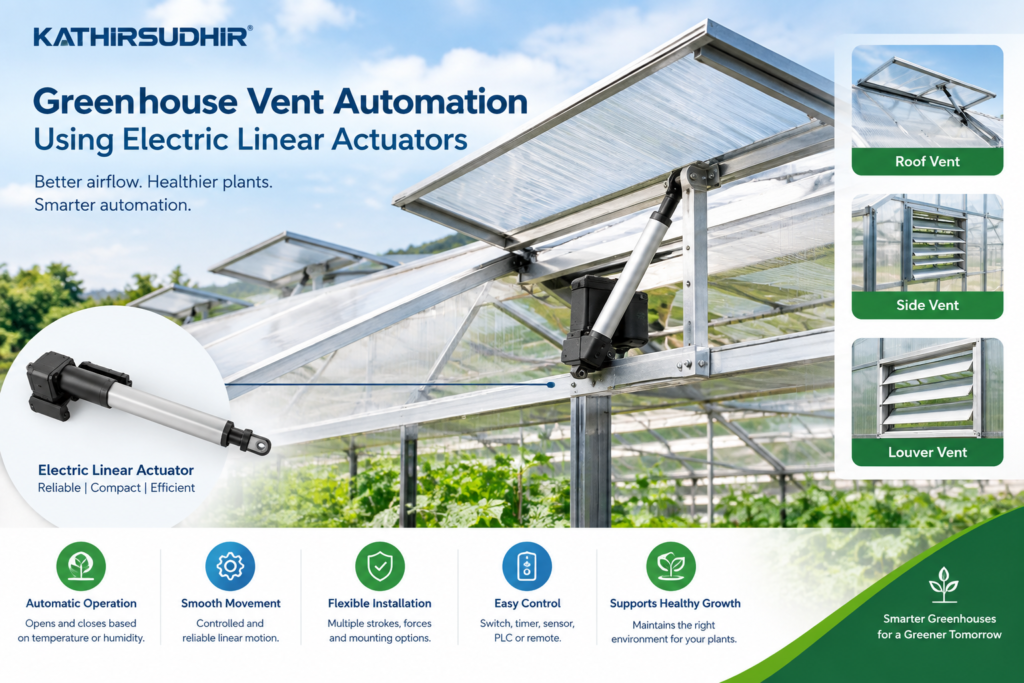
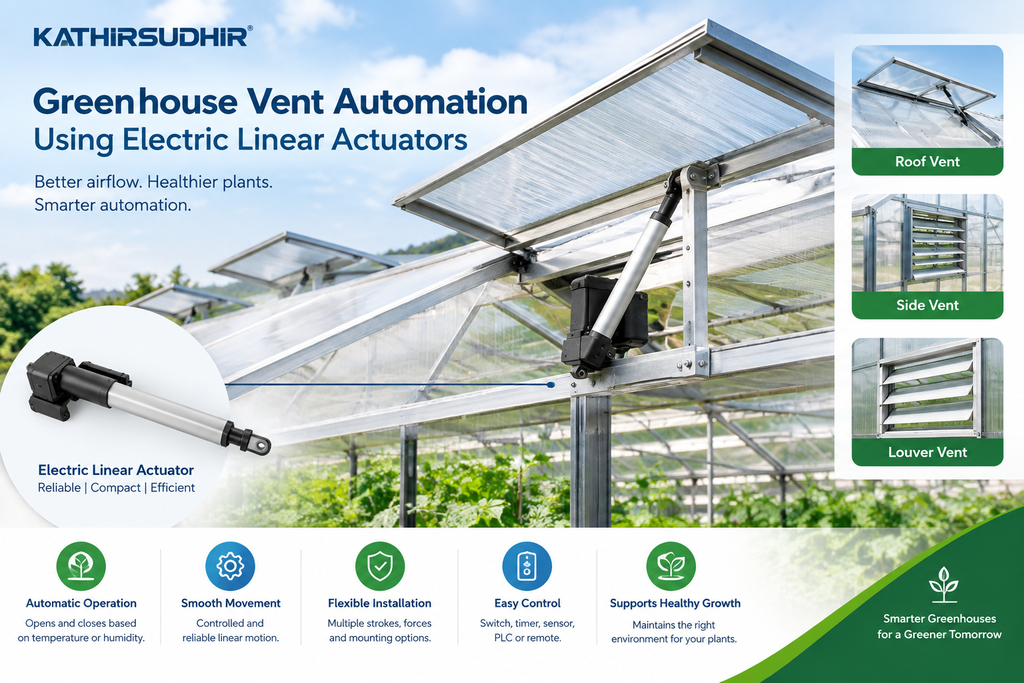
Greenhouses need proper ventilation to maintain suitable temperature and airflow for plants. Opening and closing vents manually takes time and effort.
Electric linear actuators provide a simple way to automate greenhouse vents. They can open and close roof vents, side vents, and louvers using a switch, timer, sensor, or control unit.
What Is a Greenhouse Vent?
A greenhouse vent allows fresh air to enter and hot air to escape.
Common types include:
- Roof vents
- Side vents
- Louver vents
- Exhaust vents
- Automatic window vents
How Does a Linear Actuator Work?
An electric linear actuator converts motor rotation into linear movement.
The actuator extends and retracts to open or close the greenhouse vent.
A simple system works like this:
Control Switch → Control Unit → Linear Actuator → Greenhouse Vent
When the switch or controller sends a signal, the actuator moves the vent to the required position.
Applications of Linear Actuators in Greenhouses
1. Roof Vent
A linear actuator can open and close the roof vent.
This helps release hot air from the greenhouse.
2. Side Vent
Actuators can operate side ventilation panels.
They allow fresh air to enter the greenhouse and improve airflow.
3. Louver Vent
Linear actuators can control louver openings.
The actuator pushes or pulls the louver mechanism to control airflow.
4. Automatic Temperature Control
A temperature sensor can be connected to the actuator control system.
For example:
Temperature increases → Actuator extends → Vent opens
Temperature decreases → Actuator retracts → Vent closes
This reduces the need for manual operation.
Benefits of Using Linear Actuators
- Automatic vent operation
- Less manual effort
- Smooth movement
- Easy control
- Compact installation
- Suitable for different vent sizes
- Supports sensor-based automation
How to Select a Linear Actuator
Consider these specifications before selecting an actuator:
Load Capacity
Select the actuator based on the force required to move the vent.
Stroke Length
The actuator stroke should match the required vent movement.
Common options include:
- 50 mm
- 100 mm
- 150 mm
- 200 mm
- 300 mm
- 400 mm
- 600 mm
Voltage
Common options include:
- 12V DC
- 24V DC
Speed
Select the speed based on how quickly you want the vent to open or close.
IP Rating
For greenhouse applications, select an actuator with suitable protection against dust and moisture.
Limit Switch
Built-in limit switches help stop the actuator at the end of its movement.
Typical Linear Actuator Specifications
A greenhouse actuator system might use:
- Stroke: 50 to 600 mm
- Voltage: 12V DC / 24V DC
- Force: 100 N to 8000 N
- Speed: 4 to 160 mm/s
- Control: Switch, sensor, timer, PLC, or control unit
- Feedback: Limit switch or position feedback
The exact specification depends on the greenhouse vent and mechanical design.
Automatic Greenhouse Vent Control
A simple automated system can include:
Temperature Sensor → Controller → Linear Actuator → Vent
The controller checks the temperature and operates the actuator when required.
You can also add:
- Humidity sensor
- Timer
- Remote control
- Manual switch
- Multiple actuator control
Safety Considerations
When installing a linear actuator for a greenhouse vent, consider:
- Proper actuator mounting
- Limit switches
- Overload protection
- Manual override
- Suitable IP protection
- Proper electrical wiring
- Mechanical end stops
Custom Linear Actuator Solutions
Different greenhouse vents require different actuator specifications.The actuator can be selected according to:
- Stroke
- Force
- Speed
- Voltage
- Mounting dimensions
- Feedback
- Vent size
- Control method
A customized actuator and control system can also be developed for special greenhouse automation requirements.
Conclusion
Electric linear actuators provide a simple solution for greenhouse vent automation. They help automate roof vents, side vents, and louver systems.
By combining a linear actuator with sensors and a control unit, greenhouse ventilation can be controlled automatically.
For custom actuator and automation requirements, visit Kathir Sudhir Automation India Private Limited

Kathir Sudhir Automation India specializes in advanced motion control systems, industrial automation solutions, and medical-grade linear actuator technologies for healthcare and rehabilitation equipment manufacturers.
With recognized industry certifications and multiple awards for innovation in automation systems, the company delivers reliable, high-performance electromechanical solutions tailored for medical and industrial applications.
Certifications & Recognition
Zed Bronze Certificate
Member at Confederation of Indian Industry (CII)
TANSTIA Member Certificate