
Mobility and accessibility are important factors in modern transportation. For wheelchair users, getting in and out of a vehicle safely and comfortably can be challenging, especially when manual ramps, steps, or lifting mechanisms require physical effort.
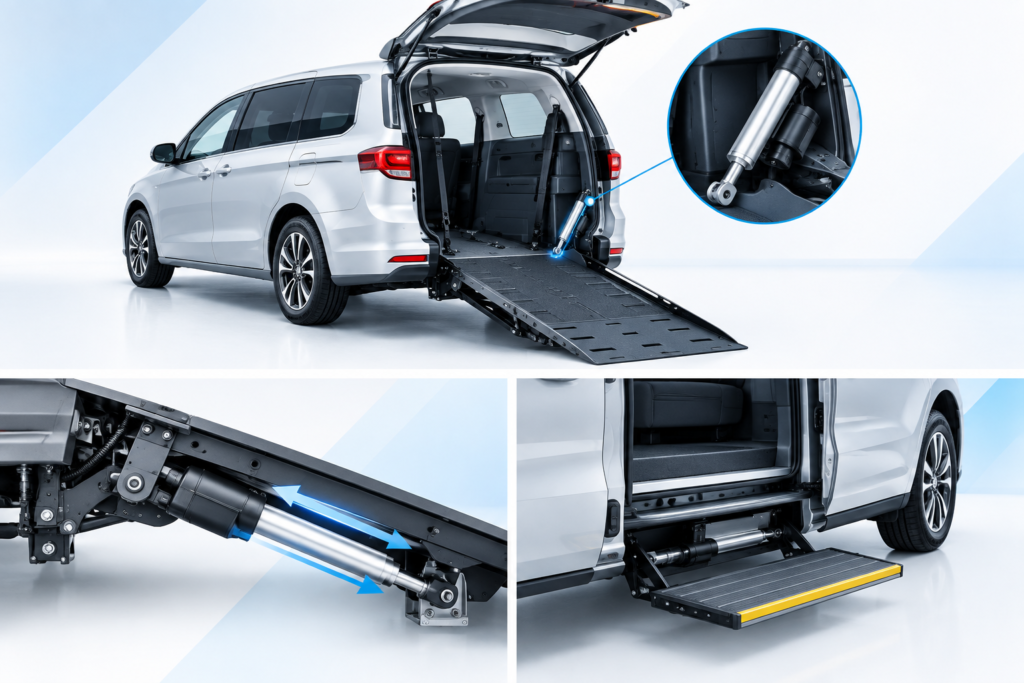
Electric linear actuators provide a practical automation solution for wheelchair-accessible vans by enabling controlled movement of ramps, lifts, steps, seats, and other accessibility mechanisms. With the push of a button or through an automated control system, these mechanisms can extend, retract, lift, lower, or adjust smoothly.
What Is a Wheelchair-Accessible Van?
A wheelchair-accessible van is specially modified to allow a person using a wheelchair to enter, exit, and travel inside the vehicle with greater convenience and safety.
Common accessibility modifications include:
- Automatic wheelchair ramps
- Retractable or folding ramps
- Wheelchair lifts
- Powered side steps
- Automatic doors
- Adjustable passenger seats
- Wheelchair restraint systems
- Lowered vehicle floors
- Powered transfer mechanisms
Electric linear actuators can be integrated into many of these systems to provide reliable powered movement.
How Electric Linear Actuators Work in Accessible Vans
An electric linear actuator converts the rotational motion of an electric motor into controlled linear movement.
Depending on the application, the actuator can push, pull, lift, lower, extend, or retract a mechanical component.
For example, in a wheelchair-accessible van:
Control Switch → Control Unit → Electric Linear Actuator → Ramp Movement
When the user activates the control switch, the actuator receives power from the vehicle’s electrical system and moves the ramp to the required position.
Once the ramp reaches its required position, limit switches or integrated position feedback can be used to stop the actuator and prevent unnecessary movement.
Applications of Linear Actuators in Wheelchair Vans
1. Automatic Wheelchair Ramps
One of the most useful applications is the automation of wheelchair ramps.
A linear actuator can:
- Extend the ramp
- Retract the ramp
- Fold or unfold the ramp
- Hold the ramp in position
- Provide controlled movement
This eliminates the need to manually handle a heavy ramp and can make vehicle access more convenient.
2. Powered Wheelchair Lifts
Linear actuators can also be used in lifting mechanisms designed to raise or lower wheelchair platforms.
Depending on the mechanical design, actuators can help control:
- Platform lifting
- Platform lowering
- Folding mechanisms
- Stabilization components
The actuator should be selected according to the required load, stroke, speed, mounting arrangement, and duty cycle.
3. Automatic Side Steps
For passengers who have difficulty climbing into a van, powered side steps can improve accessibility.
An electric actuator can extend the step when the vehicle door is opened and retract it when the door is closed.
This creates a cleaner and more convenient entry system while reducing manual operation.
4. Automatic Doors
Linear actuators can be integrated into certain automated door mechanisms to assist with controlled opening and closing.
The actuator can provide consistent movement while working with appropriate sensors, switches, and safety controls.
5. Adjustable Seating Systems
Accessible vans may require flexible seating arrangements to accommodate wheelchairs and other passengers.
Electric linear actuators can be used for controlled seat:
- Adjustment
- Sliding
- Tilting
- Lifting
- Positioning
This allows the vehicle interior to be configured according to different accessibility requirements.
Benefits of Using Electric Linear Actuators
Improved Accessibility
Powered mechanisms reduce the physical effort required to operate ramps, steps, and other components.
Smooth and Controlled Movement
Linear actuators provide controlled linear motion, making them suitable for applications where gradual movement is required.
Compact Installation
Electric actuators are available in different sizes, strokes, force capacities, and mounting configurations, allowing them to be integrated into various vehicle mechanisms.
Push-Button Operation
An actuator can be operated through switches, remote controls, control panels, or customized electronic control systems.
Customizable Motion
The actuator’s stroke length, speed, load capacity, and control method can be selected according to the application.
Choosing the Right Linear Actuator for a Wheelchair Van
Selecting the correct actuator is important for both performance and safety.
Key parameters include:
1. Load Capacity:
Determine the force required to move the ramp, platform, step, or seat.
2. Stroke Length:
The stroke must match the required movement of the mechanism.
3. Operating Speed:
Accessibility systems generally require controlled movement rather than extremely high speed.
4. Voltage:
Vehicle applications commonly use DC power systems, so the actuator should be compatible with the vehicle’s electrical system.
5. Duty Cycle:
The actuator should be suitable for how frequently the mechanism will operate.
6. Mounting Position:
The actuator’s retracted and extended dimensions must fit within the available installation space.
7. Limit Switches and Feedback:
Position feedback can help control the actuator and improve system operation.
Typical Electric Linear Actuator Specifications
Depending on the application, an electric linear actuator may be selected with specifications such as:
- Stroke: 25 mm to 600 mm or customized
- Voltage: 12V DC / 24V DC
- Load: 100 N to 8000 N
- Speed: 4 mm/s to 160 mm/s
- Control: Switch, remote, control unit, PLC, or customized controller
- Feedback: Limit switch or position feedback options
The actual specification should always be selected based on the mechanical load and movement requirements of the vehicle system.
Safety Considerations
Safety is especially important when designing accessibility equipment.
A wheelchair-accessible van should consider:
- Mechanical locking mechanisms
- Limit switches
- Emergency stop provisions where appropriate
- Overload protection
- Anti-pinch protection
- Manual override
- Proper actuator mounting
- Secure wheelchair restraint systems
- Appropriate electrical protection
The actuator should not be treated as the only safety mechanism. The complete mechanical and electrical system should be designed and tested according to the intended vehicle application and applicable safety requirements.
Electric Linear Actuator + Control System
For a more advanced accessibility system, the actuator can be combined with a dedicated control unit.
A typical system can include:
Electric Linear Actuator + Control Unit + Remote/Switch + Sensors
This can provide features such as:
- Extend/retract control
- Multiple actuator synchronization
- Position control
- Limit detection
- Remote operation
- Manual override
- Safety interlocks
For applications requiring multiple movements, customized control logic can also be developed using suitable electronic controllers.
Custom Linear Actuator Solutions for Mobility Applications
Every wheelchair-accessible van conversion can have different mechanical requirements. Therefore, an off-the-shelf actuator may not always be the ideal solution.
Custom actuator solutions can be developed based on:
- Required stroke length
- Load requirement
- Installation dimensions
- Operating speed
- Voltage
- Mounting configuration
- Feedback requirements
- Control method
- Available installation space
This makes electric linear actuators suitable for both new accessibility systems and the modernization of existing vehicle mechanisms.
Conclusion
Electric linear actuators can play an important role in developing wheelchair-accessible vans with automated mobility features. From powered ramps and wheelchair lifts to automatic steps, doors, and adjustable seating, linear motion technology can reduce manual effort and improve convenience.
With the right combination of electric linear actuators, control units, sensors, and mechanical safety systems, vehicle manufacturers and mobility solution providers can develop customized accessibility solutions for different wheelchair and passenger requirements.
Choosing the correct actuator based on force, stroke, speed, voltage, mounting dimensions, duty cycle, and safety requirements is essential for reliable performance.
For customized mobility and vehicle automation applications, electric linear actuator technology provides a flexible foundation for creating smarter and more accessible transportation solutions.

Kathir Sudhir Automation India specializes in advanced motion control systems, industrial automation solutions, and medical-grade linear actuator technologies for healthcare and rehabilitation equipment manufacturers.
With recognized industry certifications and multiple awards for innovation in automation systems, the company delivers reliable, high-performance electromechanical solutions tailored for medical and industrial applications.
Certifications & Recognition
Zed Bronze Certificate
Member at Confederation of Indian Industry (CII)
TANSTIA Member Certificate