
Traditional cellar doors and trapdoors often require manual lifting, pulling, or locking. For applications where easy operation, controlled movement, safety, and space utilization are important, an electric linear actuator provides a practical solution for automatic cellar doors and trapdoors.
By converting electrical energy into controlled linear motion, an electric linear actuator can smoothly open and close a heavy or lightweight trapdoor with the simple press of a switch, remote, push button, or automated control system.
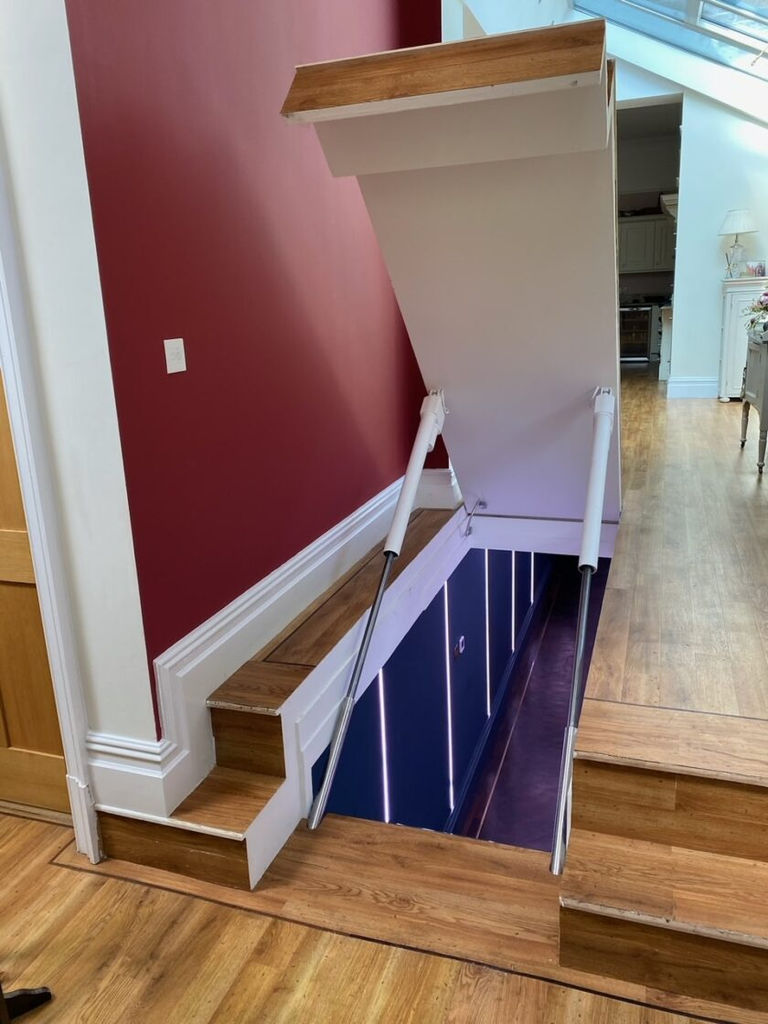
What Is an Automatic Cellar or Trapdoor System?
An automatic cellar or trapdoor system is a motorized opening mechanism designed to provide convenient access to an underground cellar, storage area, service compartment, machinery space, or concealed opening.
Instead of manually lifting the door, an electric linear actuator is connected between the fixed structure and the moving door. When the actuator extends or retracts, it creates the required pushing or pulling force to move the door.
Depending on the design, the system can be operated using:
- Push-button switches
- Remote controls
- Control panels
- Foot switches
- PLC systems
- Smart home automation
- Wireless controls
- Automated timers or sensors
How Does an Electric Linear Actuator Open a Trapdoor?
The actuator is installed between the stationary frame and the trapdoor. When an electrical command is given, the actuator motor drives an internal screw mechanism.
Opening Operation
When the actuator extends, it pushes or pulls the trapdoor through its mechanical linkage, depending on the installation arrangement. The door gradually moves to its open position.
Closing Operation
When the actuator retracts, the trapdoor returns to its closed position.
The actuator can be selected according to the door weight, stroke length, mounting geometry, opening angle, required speed, and available power supply.
Why Use Electric Linear Actuators for Cellar Doors?
Electric linear actuators offer several advantages over conventional manual opening mechanisms.
1. Easy Operation
A motorized trapdoor can be opened or closed with the press of a button. This is especially useful when the door is heavy or difficult to access manually.
2. Controlled Movement
The actuator provides controlled linear movement, helping the door open and close in a predictable manner.
3. Compact Installation
Electric linear actuators can be integrated into many different door and hatch designs without requiring large hydraulic systems.
4. Remote Operation
With a suitable control system, the cellar door can be operated using a remote control or wireless interface.
5. Heavy-Duty Applications
Higher-force actuator configurations can be used for larger and heavier access doors when the actuator and mechanical structure are correctly selected.
6. Low Maintenance
Compared with complex hydraulic systems, electric actuator systems can provide a relatively simple solution with fewer components.
Applications of Automatic Cellar and Trapdoors
Electric linear actuators can be used in a wide range of applications where a hinged or lifting access door needs motorized movement.
Common applications include:
- Residential cellar doors
- Underground storage access
- Wine cellar entrances
- Basement access doors
- Hidden floor doors
- Service access panels
- Machinery access covers
- Equipment enclosures
- Commercial storage areas
- Industrial inspection openings
- Maintenance access hatches
- Marine and specialty access doors
- Automated architectural doors
Choosing the Right Linear Actuator
Selecting the correct actuator is important for reliable and safe operation.
Several factors should be considered before choosing an actuator:
Load Capacity
The actuator must provide sufficient force to move the door under actual operating conditions. Door weight alone is not enough; the mounting position and lever geometry also affect the required force.
Stroke Length
Stroke length determines how far the actuator extends and retracts. The required stroke depends on the door dimensions, mounting points, and desired opening movement.
Opening Angle
The actuator mounting position should be calculated according to the required opening angle of the trapdoor.
Operating Speed
Different applications require different opening and closing speeds. The actuator speed should be selected according to the door size, safety requirements, and user expectations.
Voltage
Electric linear actuators are available in different DC voltage configurations. Common options include 12 V DC and 24 V DC, depending on the application and control system.
Duty Cycle
The actuator should be selected according to how frequently the cellar or trapdoor will be operated.
Safety Considerations
Safety is an important part of any automatic trapdoor design. The actuator should not be selected based only on load capacity.
The complete system should consider:
- Mechanical door supports
- Proper actuator mounting
- Limit switches
- Overload protection
- Emergency operation
- Pinch-point protection
- Door locking mechanism
- Suitable control logic
- Structural strength of the door and frame
For heavy doors, additional mechanical support such as gas springs, counterbalances, hinges, or suitable locking mechanisms may be required depending on the design.
Custom Linear Actuator Solutions for Trapdoors
Every cellar and trapdoor installation can have different dimensions, door weights, mounting positions, and opening requirements. Therefore, a standard actuator may not always provide the ideal solution.
A customized actuator system can be developed based on requirements such as:
- Required force
- Stroke length
- Operating speed
- Voltage
- Mounting dimensions
- Door size
- Opening angle
- Control method
- Operating frequency
Electric linear actuators can also be integrated with PLC, Arduino, wireless controls, remote controls, and other automation systems for customized operation.
Automatic Trapdoor Automation
For advanced applications, the actuator can be combined with a dedicated control unit to create a complete automated trapdoor system.
For example:
Input → Control Unit → Electric Linear Actuator → Trapdoor Movement
A remote or push button sends the command to the control unit. The control unit activates the actuator, which extends or retracts to move the trapdoor.
Additional sensors and control features can be incorporated depending on the application requirements.
Conclusion
Automating a cellar or trapdoor with an electric linear actuator can provide convenient, controlled, and reliable movement without the need for manual lifting.
From residential cellar doors and hidden access panels to industrial inspection hatches and heavy-duty service doors, linear actuator technology can be adapted to different door sizes and automation requirements.
The key to a successful installation is selecting the correct force, stroke, speed, voltage, mounting geometry, and control system for the specific application.
If you are looking for a customized electric linear actuator solution for an automatic cellar door, trapdoor, hatch, or access panel, the actuator can be selected and configured according to your mechanical and automation requirements.

Kathir Sudhir Automation India specializes in advanced motion control systems, industrial automation solutions, and medical-grade linear actuator technologies for healthcare and rehabilitation equipment manufacturers.
With recognized industry certifications and multiple awards for innovation in automation systems, the company delivers reliable, high-performance electromechanical solutions tailored for medical and industrial applications.
Certifications & Recognition
Zed Bronze Certificate
Member at Confederation of Indian Industry (CII)
TANSTIA Member Certificate