
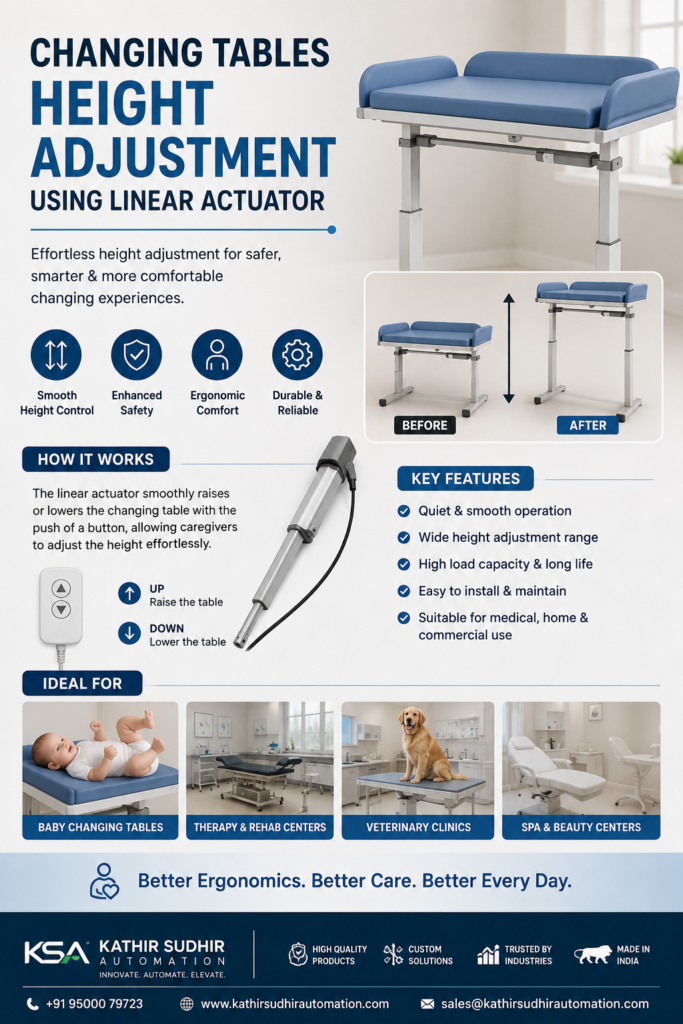
Changing Table Height Adjustment Using Linear Actuators
Easy and Safe Changing Table Height Adjustment
Changing Table Height Adjustment using electric linear actuators provides an easy and practical way to improve the usability of changing tables in childcare centers, hospitals, clinics, homes, and commercial facilities. Electric linear actuators provide smooth and controlled movement, allowing caregivers to adjust the table to a suitable working height.
A fixed-height changing table might not suit every caregiver or working environment. An electric height-adjustment system allows the table platform to move vertically using a simple hand controller, push button, or control unit.
How Changing Table Height Adjustment Works
A height-adjustable changing table uses an electric linear actuator together with a lifting frame and control system.
When the user presses the UP button, the actuator extends and moves the lifting mechanism upward. When the DOWN button is pressed, the actuator retracts and lowers the table.
A typical system includes:
- Electric linear actuator
- Control unit
- Hand controller
- Push buttons
- Power supply
- Wiring harness
- Lifting frame
- Changing table platform
- Mounting brackets
The actuator specification should match the table weight, required lifting force, stroke length, operating speed, duty cycle, and available installation space.
Benefits of Changing Table Height Adjustment
Easy Working Height Adjustment
Changing Table Height Adjustment allows caregivers to set the table according to their preferred working position. This supports different users and working environments.
Smooth Linear Actuator Movement
Electric linear actuators provide controlled movement during Changing Table Height Adjustment. The actuator speed and stroke should be selected according to the application.
Improved Ergonomics
Changing Table Height Adjustment helps caregivers work at a suitable height and reduces unnecessary bending during regular operation.
Simple Push-Button Control
A hand controller or push-button system provides a simple method for raising and lowering the changing table.
Compact Installation
Compact electric actuators fit within or below the table structure while providing the required lifting force.
Low Maintenance
Electric actuators do not require hydraulic oil, pumps, or hoses. This simplifies the system and reduces routine maintenance requirements.
Reliable Operation
A correctly selected actuator and control unit provide repeatable height adjustment for regular daily use.
Linear Actuator System for Changing Table Height Adjustment
The electric linear actuator forms the main motion component of the height-adjustment system.
The actuator receives electrical power from the control unit and converts the electrical input into linear movement. This movement operates the lifting mechanism connected to the changing table.
The complete Changing Table Height Adjustment system should be designed according to:
- Table dimensions
- Table weight
- Required lifting force
- Height range
- Stroke length
- Operating speed
- Duty cycle
- Power supply
- Mounting dimensions
- Control requirements
Correct actuator selection helps achieve stable and reliable movement.
Applications of Changing Table Height Adjustment
Height-adjustable changing tables are suitable for:
- Baby changing tables
- Childcare centers
- Daycare facilities
- Hospitals
- Clinics
- Healthcare facilities
- Public restrooms
- Commercial facilities
- Special needs facilities
- Home care environments
- Adjustable care tables
- Professional caregiver stations
Changing Table Height Adjustment is useful in environments where different caregivers use the same equipment.
Safety Features for Changing Table Height Adjustment
Safety should be considered during the mechanical and electrical design of an adjustable changing table.
Possible safety features include:
- Overload protection
- Limit switches
- Emergency stop
- Controlled actuator movement
- Mechanical safety support
- Stable mounting brackets
- Suitable actuator load capacity
- End-position protection
- Proper wiring
- Appropriate control system
The actuator, lifting frame, mounting components, and control unit should be selected according to the expected operating load.
For healthcare and childcare applications, the complete system should be properly engineered and tested for its intended use.
How to Select a Linear Actuator for Changing Table Height Adjustment
Selecting the correct actuator is important for reliable Changing Table Height Adjustment.
Consider these parameters:
| Parameter | What to consider |
|---|---|
| Voltage | 12V DC or 24V DC |
| Load | Required lifting force |
| Stroke | Required vertical movement |
| Speed | Required adjustment speed |
| Retracted length | Available installation space |
| Duty cycle | Frequency of operation |
| Mounting | Available mounting points |
| Control | Push button, hand controller, or control unit |
| Safety | Limit and overload protection |
The actuator should provide sufficient force for the table and expected load.
Electric Linear Actuators for Changing Tables
Electric Linear Actuators provide a practical method for automating Changing Table Height Adjustment.
They offer:
- Controlled linear movement
- Electrical operation
- Compact installation
- Simple control integration
- Different stroke options
- Different force capacities
- Integration with control units
For manufacturers, actuator systems can be selected according to table dimensions, lifting capacity, stroke length, speed, voltage, mounting configuration, and control requirements.
Example of Changing Table Height Adjustment
Consider a changing table used by several caregivers during the day.
The table uses an electric linear actuator connected to a lifting frame. A hand controller allows the caregiver to raise or lower the platform.
The caregiver selects the required working height using the controller. The actuator then extends or retracts to move the table.
This setup provides a simple method of Changing Table Height Adjustment without requiring manual lifting of the platform.
Frequently Asked Questions
Can a linear actuator adjust a changing table height?
Yes. A suitable electric linear actuator can raise and lower a changing table through a properly designed lifting mechanism.
What voltage is suitable for a changing table actuator?
12V DC and 24V DC systems are common options. The correct voltage depends on the actuator, control unit, power supply, and application design.
How do I select an actuator for a changing table?
Consider lifting force, stroke length, speed, duty cycle, voltage, mounting dimensions, table weight, and available installation space.
What control system is used for changing table height adjustment?
A changing table can use push buttons, a hand controller, or a dedicated control unit to operate the actuator.
Are electric linear actuators suitable for healthcare equipment?
Electric linear actuators are used in many types of adjustable equipment. The complete system should be designed and tested according to the requirements of the intended application.
Conclusion
Changing Table Height Adjustment using electric linear actuators provides a practical solution for developing adjustable changing tables. The system allows caregivers to set a suitable working height using a hand controller, push button, or electronic control unit.
With the correct actuator, control system, lifting mechanism, and safety features, manufacturers can develop reliable height-adjustable changing tables for childcare, healthcare, commercial, and home applications.
For actuator selection and custom automation requirements, Kathir Sudhir Automation provides electric linear actuator and control solutions for different applications.

Kathir Sudhir Automation India specializes in advanced motion control systems, industrial automation solutions, and medical-grade linear actuator technologies for healthcare and rehabilitation equipment manufacturers.
With recognized industry certifications and multiple awards for innovation in automation systems, the company delivers reliable, high-performance electromechanical solutions tailored for medical and industrial applications.
Certifications & Recognition
Zed Bronze Certificate
Member at Confederation of Indian Industry (CII)
TANSTIA Member Certificate