
/ Blog
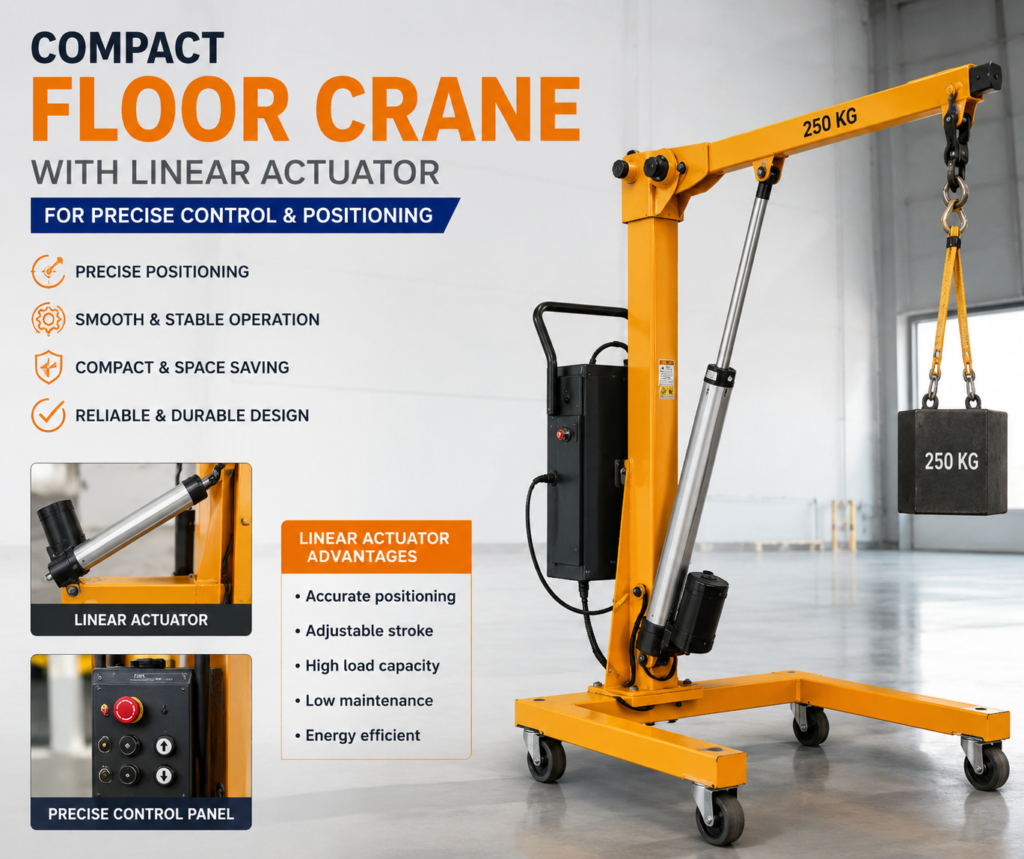
You need safe, accurate, and effortless lifting solutions for patient handling and mobility assistance. A compact floor crane with linear actuator technology provides smooth movement, precise positioning, and reliable lifting performance for healthcare environments. This guide helps you understand how linear actuator-based floor cranes improve safety, efficiency, and user comfort.
Linear Actuator Floor Crane
Overview and Key Aspects
A complete compact floor crane system includes:
- Electric linear actuator lifting mechanism
- Strong mobile base frame with caster wheels
- Adjustable lifting arm and spreader bar
- Hand controller for movement adjustment
- Battery-powered control system
- Safety limit switches and overload protection
Key Facts You Need:
- Actuator voltage: 24 VDC
- High-force lifting capability
- Smooth vertical positioning control
- Low-noise operation
- Compact design for hospitals and care facilities
- Suitable for patient transfer applications
How It Works
A linear actuator converts electrical energy into controlled linear movement.
Working process:
- Electric motor inside the actuator receives power from the controller.
- The actuator extends or retracts to move the lifting arm.
- The crane raises or lowers the patient support system smoothly.
- Limit switches stop movement at predefined positions.
- The controller provides accurate height adjustment.
Visual: System Layout
Main Components:
- 24V DC Linear Actuator
- Control Box
- Battery Pack
- Lifting Column/Arm
- Base Frame
- Patient Sling Attachment
Key Application Areas and Reasons
Healthcare Applications
- Patient transfer systems
- Nursing homes
- Hospitals
- Rehabilitation centers
- Home healthcare equipment
Why You Use a Linear Actuator Floor Crane:
- Precise lifting control
- Reduced physical effort for caregivers
- Smooth patient positioning
- Improved patient safety
- Compact movement in limited spaces
Key Features and Technology
High Precision Linear Actuator
Provides:
- Accurate positioning
- Controlled lifting speed
- Stable load movement
- Reliable operation
Electric Control System
Features:
- Handheld remote operation
- Adjustable movement control
- Battery-powered operation
- Emergency stop function
Safety Protection
Includes:
- Overload protection
- Limit switches
- Anti-collision design
- Stable wheel locking system
Required Components
A compact floor crane with linear actuator requires:
- Electric linear actuator
- Motor controller
- Rechargeable battery system
- Lifting frame
- Patient sling support
- Control handset
- Safety sensors
Comparison Table
| Feature | Linear Actuator Floor Crane | Manual Floor Crane |
|---|---|---|
| Lifting Control | Precise electric control | Manual adjustment |
| Operation | Easy push-button movement | More physical effort |
| Position Accuracy | High | Medium |
| Noise Level | Low | Depends on operation |
| Caregiver Effort | Reduced | Higher |
Operations and Functions
A linear actuator-based floor crane performs:
- Up and down lifting movement
- Controlled patient transfer
- Height adjustment
- Smooth positioning
- Safe lowering operation
Steps to Follow
- Identify required lifting capacity.
- Select suitable linear actuator force rating.
- Choose voltage and stroke length.
- Design frame according to application.
- Install control and safety systems.
- Test movement and load performance.
A compact floor crane uses a powerful 24V linear actuator from Kathir Sudhir Automation India Pvt Ltd to achieve smooth lifting, accurate positioning, and reliable patient handling performance.
Checklist for You
✔ Required lifting capacity confirmed
✔ Stroke length selected
✔ Voltage compatibility checked
✔ Safety features included
✔ Battery backup available
✔ Patient handling requirements verified
Example Use Case
A rehabilitation center installs a compact floor crane with a 24V DC linear actuator.
Results:
- Easier patient transfers
- Reduced caregiver workload
- Improved positioning accuracy
- Safer daily operations
Key Benefits and Specifications
Specifications
- Voltage: 24 VDC
- Actuator Type: Electric Linear Actuator
- Application: Patient lifting equipment
- Control: Electric handset/controller
- Movement: Linear lifting adjustment
Benefits
- Precise control
- Smooth operation
- Compact installation
- Low maintenance
- Improved safety
Advantages and Disadvantages
Advantages
- Accurate positioning
- Easy operation
- Reduced manual handling
- Suitable for healthcare automation
- Long service life
Disadvantages
- Higher initial investment
- Requires electrical maintenance
- Battery charging needed
Key Prevention Techniques
- Select correct actuator force rating
- Avoid overloading the crane
- Inspect actuator connections regularly
- Maintain battery health
- Test safety switches periodically
Compliance and Best Practices
- Follow medical equipment safety guidelines
- Use certified electrical components
- Maintain hygiene standards
- Perform regular inspections
- Ensure proper caregiver training
Pro Tip
Choose a linear actuator with the correct stroke length and force capacity. Proper actuator selection improves lifting stability, reduces wear, and increases equipment life.
Conclusion
A compact floor crane with linear actuator technology provides precise control, safe lifting, and smooth patient positioning. By selecting the right actuator force, stroke length, and control system, healthcare facilities can improve efficiency and reduce manual handling challenges.
Linear actuator-powered floor cranes are an effective solution for modern patient care environments requiring reliability, accuracy, and safety.
People Also Ask
1. What is a linear actuator used for in a floor crane?
A linear actuator provides controlled lifting and positioning movement in electric floor cranes.
2. Why use a 24V linear actuator for patient lifting equipment?
A 24V linear actuator provides safe, efficient, and reliable operation for healthcare applications.
3. How does a linear actuator improve crane positioning?
It allows precise extension and retraction control for accurate lifting height adjustment.
4. What factors should be considered when selecting a linear actuator?
Consider voltage, force capacity, stroke length, speed, and duty cycle.
5. Where are compact floor cranes with linear actuators used?
They are used in hospitals, nursing homes, rehabilitation centers, and home healthcare.
6. Can linear actuators handle heavy lifting applications?
Yes, heavy-duty linear actuators are designed for high-force lifting applications.
7. What are the benefits of electric patient lifting systems?
They reduce caregiver effort, improve safety, and provide smoother patient transfers.
8. How long does a medical linear actuator last?
Service life depends on load, usage frequency, maintenance, and operating conditions.
9. Who manufactures linear actuators for medical equipment?
Industrial automation manufacturers provide customized linear actuator solutions for healthcare equipment.
10. How to choose the best linear actuator for a compact floor crane?
Select based on required lifting force, stroke length, speed, voltage, and application requirements.

Kathir Sudhir Automation India specializes in advanced motion control systems, industrial automation solutions, and medical-grade linear actuator technologies for healthcare and rehabilitation equipment manufacturers.
With recognized industry certifications and multiple awards for innovation in automation systems, the company delivers reliable, high-performance electromechanical solutions tailored for medical and industrial applications.
Certifications & Recognition
Zed Bronze Certificate
Member at Confederation of Indian Industry (CII)
TANSTIA Member Certificate