
Material handling has transformed dramatically with the rise of intelligent automation. Today’s warehouses, logistics hubs, and manufacturing units rely on electric linear actuators to achieve higher precision, faster throughput, and safer operations. From motion control systems to order picking optimization, actuators play a vital role in every stage of material movement.
This blog explores how electric actuators integrate with robotics, sensors, and intelligent controllers to deliver efficient, reliable material handling.
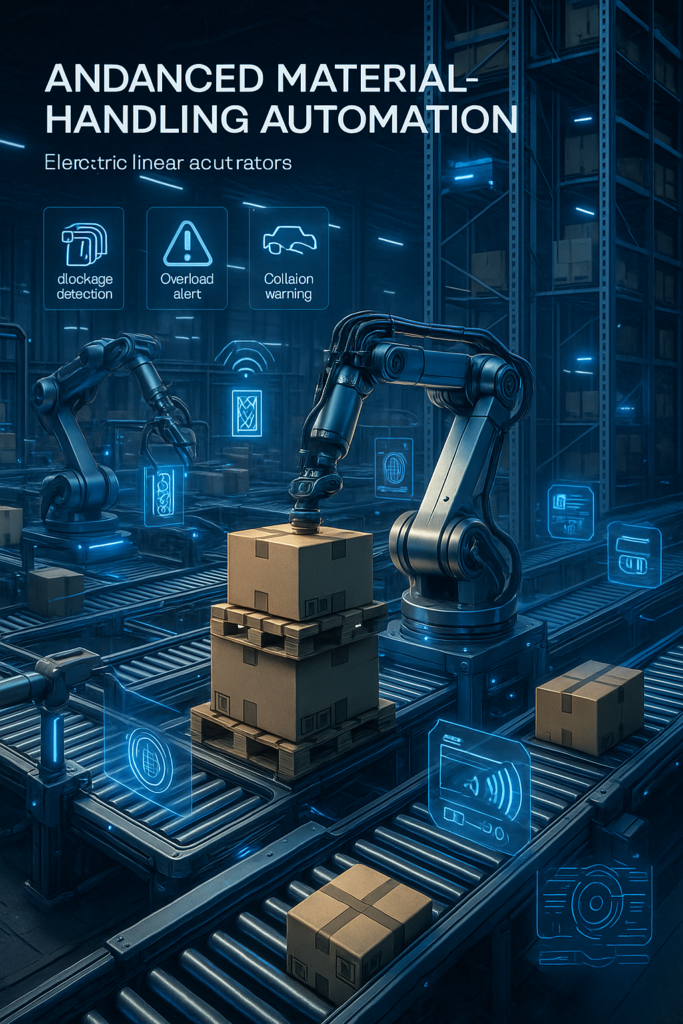
1. Precision Motion Control for Every Workflow
Electric linear actuators are at the heart of modern motion control systems. Their smooth, accurate movement helps automate diverse operations such as lifting, sliding, pushing, diverting, and aligning materials across the shop floor.
These actuators ensure:
- Stable and repeatable positioning
- Synchronized movement with conveyors and robots
- Reduced mechanical wear and maintenance
With precise motion control, production lines operate consistently even under high loads.
2. Order Picking Optimization Through Automation
In large warehouses, speed and accuracy are everything. Electric actuators assist in order picking optimization by:
- Adjusting pick arms
- Lifting and placing cartons
- Positioning trays for pickers
- Operating diverters during high-speed sorting
This eliminates manual delays and ensures rapid, error-free movement of goods.
3. Powering Palletizing Robotics
Modern palletizing robotics rely heavily on servo and electric actuators for:
- Z-axis lifting
- End-of-arm gripping
- Layer forming
- Precision carton placement
Servo actuators for precision gripping and positioning ensure delicate, uniform stacking—perfect for fragile, boxed, or bagged products.
4. Cross-Docking Automation for Fast Throughput
Cross-docking facilities demand immediate product redirection. Electric actuators enable:
- Rapid lane switching
- Linear actuators adjusting diverters and gates
- High-speed conveyor routing
This minimizes handling time and improves the flow of goods from inbound to outbound without storage delays.
5. Smarter Inventory with Tracking Integration
Electric actuators seamlessly pair with:
- Barcode/RFID integration
- Smart inventory tracking systems
- Real-time database updates
This ensures every movement is tracked, recorded, and verified—eliminating mismatches and improving traceability.
6. Automation in AS/RS and Pick-and-Place Systems
In automated storage and retrieval systems (AS/RS), actuators handle tasks such as:
- Bin lifting
- Shuttle movement
- Telescopic arm extension
In pick-and-place automation, they deliver:
- Fast cycle rates
- Repeatable positioning
- Low-noise, energy-efficient operation
This makes them ideal for electronics, FMCG, pharmacy, and e-commerce operations.
7. Safety Alerts and Diagnostics for Smarter Operations
Modern material handling equipment requires self-diagnostics and automated safety. Actuators support multiple alert systems such as:
- Blockage detection alarms
- Overload alarms
- Collision warning alert systems
- Battery low alert
- Misalignment detection alert systems
These ensure early warnings, prevent downtime, and keep operators safe.
8. Mobility Automation: Electric Actuators Drive Wheels
In AMRs and AGVs, electric actuators drive wheels, rotate sensors, adjust lift modules, and control modular tool attachments. This improves:
- Mobility accuracy
- Obstacle avoidance
- Load shifting
- Path optimization
Combined with onboard sensors, they deliver autonomous and efficient movement.

Kathir Sudhir Automation India specializes in advanced motion control systems, industrial automation solutions, and medical-grade linear actuator technologies for healthcare and rehabilitation equipment manufacturers.
With recognized industry certifications and multiple awards for innovation in automation systems, the company delivers reliable, high-performance electromechanical solutions tailored for medical and industrial applications.
Certifications & Recognition
Zed Bronze Certificate
Member at Confederation of Indian Industry (CII)
TANSTIA Member Certificate